Showing posts with label donkey kong. Show all posts

Saturday, February 28, 2026

Platform Game Compilation Review: Donkey Kong Classics


Donkey Kong Classics compiles the Nintendo Entertainment System ports of the first two Donkey Kong arcade games, Donkey Kong and Donkey Kong Junior, into one multicart. 

As noted above, the two most popular games in the original trilogy were both included, which is great since they were the best in the series up to the time of this multicart's release in 1988. It does not include Donkey Kong 3, which likely contributed to that game becoming lesser known than the others.

Donkey Kong was a solid conversion of the arcade game. However, since it was also an early release before mappers extended the capabilities of the Nintendo Entertainment System, it lacks the cement factory stage. That stage would not be added to the Nintendo Entertainment System version until Donkey Kong Original Edition was released for the Virtual Console for Wii in 2010 and Nintendo 3DS in 2012.

Donkey Kong Junior, on the other hand, survives in-tact in its conversion from arcade to NES. Although it was also an early NES game, all of the levels are here. The only real difference, as with Donkey Kong, is the change from a vertically-oriented arcade monitor to the horizontally-oriented, nearly square resolution of the NES hardware.

The multi-cart has one small difference in the games. The title screen in both games are replaced by a single blue Donkey Kong Classics title screen. The games can be selected via the right and left buttons on the NES controller, and the number of players can be selected via a menu below the game select area. The neat thing about this change is that the title screen music from the two games are alternatingly played on the multi-cart's title screen.

Donkey Kong Classics is an interesting compilation of the Nintendo Entertainment System conversions of the first two Donkey Kong games. Unlike Nintendo's earlier multi-carts, such as the Super Mario Bros. / Duck Hunt pack-in cartridge, the menu is not silent. The games lack title screens, in favor of a single title screen that controls the options of both games. This isn't a bad thing, especially since the title screen music from the both games are alternated on the multi-cart menu. It's a shame that Donkey Kong 3 wasn't included, but the game was the weakest of the original trilogy, so its exclusion is not a big loss.

Final Verdict:
3 out of 5

Thursday, February 26, 2026

Shoot 'Em Up Review: Donkey Kong 3 - The Great Counterattack


Donkey Kong 3: The Great Counterattack was one of the weirder games that Hudson Soft designed and published during their deal with Nintendo to release the games of the latter on Japanese consoles. 

The original arcade version of Donkey Kong 3 was already a weird game. Nintendo took Mario out of the question and replaced him with a now-forgotten character named Stanley the Bugman. In doing so, the genre was changed from platformer to static shoot 'em up as Stanley used his bug spray to blast a parachuting Donkey Kong out from his greenhouse.

Hudson Soft takes this weird premise further by eschewing the greenhouse completely and replacing it with stages set in lands near and far. Without Stanley's greenhouse, the bugs no longer try to take his plants. Instead, they now act like the bugs from Galaga, coming after Stanley in various attack patterns. They now also shoot blasts downward at the erstwhile greenskeeper.

To be able to tie this oddball of a setup with Donkey Kong 3, Stanley still uses his bug spray to blast not only the bugs, but Donkey Kong as well. This works the same as the arcade game, as when Donkey Kong is blasted far enough up the screen, the location changes and Stanley starts the battle anew.

Donkey Kong's initial appearance is greeted by the classic tune from the original arcade game. The end of each stage has a little fanfare of a tune. Most of the game is silent, interspersed by blasting sounds and the dropping sound of Donkey Kong's parachute.

There are twenty-five stages that see Stanley spraying baddies. He first is on the highway with a rocky hillscape during sunset. He then finds himself at night on a strange bridge, which appears to be a normal bridge with a safety fence on both sides. Things become even weirder after this, as Stanley finds himself leaving the Earth, now battling Donkey Kong in the black vastness of space with the third planet from the sun appearing behind them. 

The Galaga connection deepens, as after every five levels, Stanley finds himself dealing with bugs on a challenging stage with no background. Like Namco's classic, he has to try to get rid of as many bugs as he can while a timer ticks away until the bonus round completes.

They then fight in the Astron Belt, a rocky outcrop in space that shares a name with a Laserdisc arcade game by Sega. The sparring pair travel around Saturn, past a mysterious planet that does not appear to be part of the Milky Way galaxy, and back to Earth again. Back on terra firma, they fight in a desert, by a pyramid, in a cave. They then tussle outside an active volcano before heading inside the active crater. Things get more mundane as they fight outside a dome, above Nazca lines, and on a runway.

Weirdly, they then find themselves at the site of a nuclear explosion with a mushroom cloud behind them. They apparently face introspection after that, as they take in the sight of seagulls at sunset. Finally they show up at a city, on a country road, in front of non-descript giant green aliens. Finally, at level 25, the two spar inside of a UFO. This must be the way the two made their way back to Earth, as Donkey Kong has been in many more projects after this. As for Stanley, the experience must have made him put away his bug spray for good, as he has become relegated to the history books after the release of this game.

Donkey Kong 3 - The Great Counterattack is one of the weirder Nintendo-licensed games by Hudson Soft, but it is also strangely one of their better games. Outside of Excitebike, Hudson Soft didn't really make straight ports. Hudson Soft was licensed by Nintendo to make games for the 8-bit Japanese computers of the time. They couldn't really handle most Nintendo games, which is why the world got the ambitious but lacking Super Mario. Bros Special. With this game, they were able to make a game that stayed within the specifications of the hardware, but still remained fun. It's certainly a oddball of a concept, but it smartly follows the static shooter framework made famous by Namco's Galaga series. It's a far cry from any game in that series, but it's competent and worth trying for its utter weirdness alone.

Final Verdict:
3 out of 5

Thursday, March 9, 2023

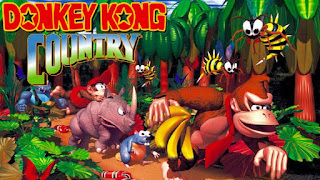
Platform Game Mega Review: Donkey Kong Country


Donkey Kong Country, a platform game by Rare based on the Nintendo character Donkey Kong, was so popular that it created a series that still continues to this day.

The plot of the game is simple in that it is just a quest to get Donkey Kong's stolen banana stash back from King K. Rool. It stars a gorilla named Donkey Kong, the son of Donkey Kong Jr., and the grandson of the original Donkey Kong who now goes by Cranky Kong. He is joined by a monkey named Diddy Kong, who is an original character created for this game. Rare's original intention was to use Donkey Kong Jr., but when Nintendo didn't accept their redesign of Junior, they created their own original character instead.

Donkey Kong is a slow brute that can kill enemies that Diddy cannot as well as find secrets by slam jumping on the floor. On the other hand, Diddy Kong can move faster as well as jump higher, allowing him to get to areas that Donkey Kong can not. One character is played at a time and can be swapped at will as long as the current Kong's partner is present. If a partner is present when hit by an enemy, that Kong will run away and will be replaced as the player Kong. There are DK barrels that contain the partner Kong if he is not with the player Kong.

The game world is populated with crocodile-like creatures known as Kremlings, which were originally intended for a point-and-click adventure that was cancelled by Rare prior to this game's release. One of the things that makes this game unique is that the Kongs can ride an animal companion. These range from the quick ostrich, to the rhino that can defeat enemies and find hidden passages with his horn, to the swordfish that makes swimming underwater easier and also acts much like the rhino in that he can defeat enemies with his sword-like snout.

Another unique thing about this game is the many barrels that are dotted along the path, especially in later levels. This is a clever take on the original Donkey Kong arcade game that had DK toss out barrels to try to trip up Mario. Here, the Kongs jump from barrel to barrel. There are barrels that go up and down and barrels that spin. These require the right timing in order to shoot to the next barrel rather than falling to your doom. There are also barrels with stars. These shoot the Kongs out as soon as they land in them. These sometimes shoot to other barrels and sometimes shoot up to hidden areas.

The early computer-generated imagery that was converted to sprites still looks good. The backgrounds, especially, are eye-catching and gorgeous. Because of the low resolution of the SNES, the characters look a lot like pixelated versions of clay models, which works in the game's favor. 

The music is great as well. I remember getting a promo VHS for this game and being impressed with both the graphics and the music. The underwater music is particularly memorable for its calm quality yet with a bit of a bubbly feel that works perfectly for the water levels. 

This game led to two more Super Nintendo Entertainment System games, three Game Boy games, two modern game revivals, and many spin-offs. It also had a Game Boy Advance remake that played just like the SNES version yet had brighter colors to compensate for the lack of a backlight in the original GBA model. The easiest way to play the game today is with an emulated version. The Wii, New Nintendo 3DS, and Wii U Virtual Console versions are no longer available, and neither is the version in the Super Nintendo Entertainment System Classic Edition. However, as of this writing, the game is available in the emulator for the Nintendo Switch Online service for the Nintendo Switch console. 

Donkey Kong Country is a fantastic game that has stood the test of time. The graphics and music are top-notch. The gameplay is excellent as well, leading to many sequels as well as inspiring other games that came after it. Because of the game's popularity, it has been ported and emulated on many of Nintendo's consoles. No matter how you choose to play the game though, it is a game that is well worth playing.

Final Verdict:
4½ out of 5

Saturday, March 4, 2023

Kart Racing Game Review: Mario Kart 64


Mario Kart 64 was the second game in Nintendo's popular Mario Kart series. It was also the game that brought the series into true three-dimensional gaming.

Mario Kart 64 was released on the Nintendo 64 which, save for the Super FX and Super FX2 chips in some Super Nintendo Entertainment System games, was Nintendo's first console that was capable of three-dimensional graphics. Unlike series that had to be redefined for 3D, such as Super Mario 64 and The Legend of Zelda: Ocarina of Time, the Mario Kart series was made for three-dimensional gameplay.

Super Mario Kart faked 3D with Mode 7 programming that manipulated flat course graphics to twist and turn them around a two-dimensional sprite. This game took the series into true 3D for the first time, but the designers kept what had worked so well in the previous game, despite being less restricted. Courses were slightly larger but were still relatively small and tight to avoid monotony. There are still three speeds of play, 50cc, 100cc, and 150cc, with championship cups themed after locations in the Mario series.

Like the previous game, kart racers encompass the entirety of the Mario franchise at that point. Donkey Kong, replacing Donkey Kong Jr., represents the arcade era. Bowser, Toad, and Princess Peach represent the Nintendo Entertainment System era. Wario, replacing the Koopa Troopa, represents the Game Boy era, and Yoshi represents the SNES era. Mario and Luigi represent the franchise as a whole.

Each kart racer had its strength and weaknesses. Bowser, Wario, and Donkey Kong are heavy, starting off slow but they become the fastest racers when they get going. Their big drawback is that if they hit obstacles it takes them a long time to regain their speed. Peach, Toad, and Yoshi are the best all-around drivers. Their karts aren't the fastest, but they regain their speed quickly. Mario and Luigi fall somewhere in the middle.

At certain points in the courses, there are diamond boxes with question marks on the ground. These replace the question panels on the ground from Super Mario Kart. They contain powerups as well as objects that can be left on the course. 

There are objects that can be dropped, including the banana peel which is dropped behind the kart, and the green Koopa shell which is shot in front of the kart and bounces off walls until it hits a driver, obstacle, or water. The banana can be shot in front of the kart by pressing up on the directional pad and the shell can be dropped, stationary, behind the kart by pressing down. There is also a red shell, which will hit the first driver it comes across unless it hits an obstacle or water. All of these items can now be obtained in a bunch of three which can be fired or used as a shield against attacks.  

There is a lightning bolt that makes the other drivers tiny, the starman which turns a kart driver invincible, and a ghost that steals an item from another driver. A mushroom causes the kart to do a boost, similar to the effect when you drive over a three-tiered arrow. The mushrooms can also be picked up in a group of three. There is also now a super mushroom that allows the player to boost over and over within a fixed time. Another item that was added was the notorious spiny shell, which hits the kart in first place.

My favorite change is that the enemy characters pick up random objects like player characters, instead of using objects related to their character. It is a lot more fun than before because Mario and Luigi don't have a supply of unlimited starman to make them invincible. They would commonly activate it near the finish line to try to trip you up. As a result, characters run by artificial intelligence don't seem as annoying as before.

Mario Kart 64 is a classic as it took what worked in the previous game and made it better. It also added features to make the game fairer. The primitive 3D graphics are somewhat mitigated by the cartoon aesthetic. This is a fantastic game that deserves to be played by anyone who is a fan of kart racing games,

Final Verdict:
4½ out of 5
Mario Kart
Super Mario Kart ReviewMario Kart: Super Circuit Review Coming Soon
Donkey Kong

Saturday, February 25, 2023

Arcade Shoot 'em Up Review: Donkey Kong 3


Donkey Kong 3 ditches Mario and platforming and pits Donkey Kong, and bugs, against Stanley the Bugman.

As with most games of the era, Donkey Kong 3 has a simple plot. Donkey Kong takes over a greenhouse. Stanley uses his bug spray to chase Donkey Kong away and to keep the bugs from ruining the flowers.

It plays like a static shooter. Stanley can run across the floor and jump up and down the platforms at will. Donkey Kong inches down the vines he is on, and Stanley needs to keep spraying him to chase him out of the greenhouse. Making this task harder is multiple bugs that get in the way of his spraying as well as try to steal his flowers. So, Stanley has to spray the bugs that try to take his plants and spray past the bugs crawling on the platforms to shoo Donkey Kong away. Stanley will lose a life if the bugs take all of his flowers. More lives can be earned by reaching 50,000 points.

Once Donkey Kong is chased away in one level and he returns again in the next. There are three levels that repeat with each progressive level getting harder than the last. 

Donkey Kong 3 is acceptable as a concept, but fans didn't take to the game, and it's easy to see why. It is weird that Nintendo followed up two popular arcade platformers with an arcade shooter. Stanley the Bugman was relegated to history, other than in a Game & Watch game, a Hudson Soft shooter, and minor appearances in the Super Smash Bros. games. Like other games in the Donkey Kong series, Donkey Kong 3 has been ported to many platforms. If you want to try it, the arcade version remains the best and, since it was finally released by Hamster for the Nintendo Switch in 2019, is the version to play.

Final Verdict:
3 out of 5
Donkey Kong Junior reviewMario Kart 64 Review

Thursday, October 3, 2019

Arcade Platform Game Review: Donkey Kong Junior


This review was originally posted on the McMurray Internet Channel website on December 19, 2018.

Donkey Kong Junior is the first game that pits Mario as an enemy to the player character. The latter is the titular Donkey Kong Jr., who must rescue his father from Mario, who has caged the gorilla due to his repeated attempts to steal Mario’s girlfriend in the previous game.

As this game stars a primate, there is a lot of climbing involved. Donkey Kong Jr. must climb up vines, ropes, and chains while avoiding the obstacles Mario sends after him such as crocodiles and electrical sparks. He will climb slowly when transcending a single vine, but if he climbs two at once, he will move faster.

The level design is quite well made in this game. It’s still a single screen, like its predecessor, but there are now much more varied obstacles than before, including trampolines and chains that raise and drop in height. Because of this level of variety, I recommend this game even more than the original.

Like the first game, Donkey Kong Junior was ported to many different systems, including the Atari 2600, Intellivision, Colecovision, Atari 8-bit computers, Nintendo Entertainment System, BBC Micro, Commodore-64, VIC-20, Coleco Adam, Famicom Disk System, and Atari 7800.

Also like the first game, outside of the original arcade version, the NES version was the most accurate of the versions. This version was emulated on the Nintendo 64 (in Animal Forest), e-Reader, Game Boy Advance, GameCube (in Animal Crossing), Wii, Nintendo 3DS, Wii U, Famicom Mini, and the NES Classic Edition.

The game is a classic that deserves to be played by everyone. The best version remains the original arcade release, which was finally officially emulated in its entirety by Hamster as part of its Arcade Archives line on the Nintendo Switch on December 21, 2018.

Final Verdict:
4 out of 5

Wednesday, October 2, 2019

Arcade Platform Game Review: Donkey Kong


This review was originally posted on the McMurray Internet Channel website on December 8, 2018. It was updated to include newer systems on which the game was included as well as to add links on June 9, 2025.

Donkey Kong was the first game designed by Shigeru Miyamoto. Nintendo of America had many unsold Radar Scope arcade games and asked for a new game that could be shipped as a conversion kit for those cabinets. The management at Nintendo asked designers for game ideas, and the idea by Miyamoto (who had previously designed the case for the Color TV-Game Block Breaker console) was chosen.

The original concept was to be based on Popeye, but Nintendo couldn’t acquire the rights at the time. So, the broad character types were given to new characters. Popeye the Sailor became a carpenter, Bluto became the carpenter’s pet gorilla, and Olive Oyl became the carpenter’s girlfriend.

The carpenter was originally named Ossan, a nickname for a middle-aged man. He was then named Mr. Video, as Shigeru Miyamoto intended him to be an everyman character to use in any game that he created. When Donkey Kong was released, he was labeled Jumpman on the cabinet of the Japanese release of Donkey Kong, and Mario for the North American release. This name, as well as Mario’s Italian-American heritage, came from a man named Mario Segale. He was the landlord of a warehouse which was rented at the time by Nintendo of America.

Mario’s pet gorilla was named Donkey Kong, chosen because the designers wanted to signify that he was a dimwitted creature. In 1984, lawyers for Universal sued Nintendo over the name, which it claimed infringed on its King Kong trademark, but Nintendo won the case. The Nintendo lawyer, and future chairman, Howard Lincoln, noted that Universal themselves proved that the plot of King Kong was in the public domain in a court case against RKO Pictures in 1976.

Mario’s girlfriend was named Lady on the cabinet of the Japanese release of Donkey Kong, and Pauline for the North American release. This name came is said to come from a woman named Polly James, who was the wife of Don James, the warehouse manager at Nintendo of America.

Mario’s trademark hat, overalls, and mustache were designed to overcome the limitations of the hardware of the time. This design made it easy to distinguish his arm and leg movement, as well as his face. It also gave the game a unique aesthetic compared to the other games of the time period.

The object of the game is to have Mario climb platforms in order to rescue Pauline from Donkey Kong. Mario must dodge the barrels thrown by Donkey Kong, as well as other obstacles in the way. Once Mario completes a stage, Donkey Kong will carry Pauline off to the next stage. Each stage is presented in meters, with the game asking Mario how high he’ll be able to get. The four stages are named by height: 25m, 50m, 75m, and 100m. Once 100m is completed, Mario will reunite with Pauline, only for Donkey Kong to kidnap her again and the game will repeat the four levels again. Like other arcade games of the time, the game gets harder as it goes on and the object is to get the highest score.

The game was ported to many systems, including the Atari 2600, Intellivision, Colecovision, Atari 8-bit computers, Nintendo Entertainment System, TI-99/4a, PC Booter, Commodore 64, VIC-20, MSX, ZX Spectrum, Amstrad CPC, Coleco Adam, Famicom Disk System, and Atari 7800.

Outside of the original arcade version, the NES version was the most accurate of the versions, except for the missing 50m, or factory stage. This version was emulated on the Nintendo 64 (in Animal Forest), Game Boy Advance, Game Boy Advance e-Reader, GameCube (in Animal Crossing), iQue Player (in Animal Forest), Wii, Nintendo 3DS, Wii U, Famicom Mini, and the NES Classic Edition.

A more arcade-accurate version for the NES called “Donkey Kong: Original Edition” was released in 2010 for Wii in Europe pre-installed on red Mario 25th anniversary Wii consoles. It was later released on 3DS in 2012. The NES version was released via emulation on the Nintendo Switch for Nintendo Switch Online subscribers in 2018. It was included via the GameCube version of Animal Crossing via emulation on Nintendo Switch 2 for Nintendo Switch Online Expansion Pass subscribers in 2025.

The game remains a classic and is worth playing even today. The best version remains the original arcade release, which was finally emulated in its entirety by Hamster as part of its Arcade Archives line on the Nintendo Switch on August 16, 2018.

Final Verdict:
4 out of 5
Donkey Kong Junior review