Showing posts with label shoot 'em up. Show all posts

Thursday, February 26, 2026

Shoot 'Em Up Review: Donkey Kong 3 - The Great Counterattack


Donkey Kong 3: The Great Counterattack was one of the weirder games that Hudson Soft designed and published during their deal with Nintendo to release the games of the latter on Japanese consoles. 

The original arcade version of Donkey Kong 3 was already a weird game. Nintendo took Mario out of the question and replaced him with a now-forgotten character named Stanley the Bugman. In doing so, the genre was changed from platformer to static shoot 'em up as Stanley used his bug spray to blast a parachuting Donkey Kong out from his greenhouse.

Hudson Soft takes this weird premise further by eschewing the greenhouse completely and replacing it with stages set in lands near and far. Without Stanley's greenhouse, the bugs no longer try to take his plants. Instead, they now act like the bugs from Galaga, coming after Stanley in various attack patterns. They now also shoot blasts downward at the erstwhile greenskeeper.

To be able to tie this oddball of a setup with Donkey Kong 3, Stanley still uses his bug spray to blast not only the bugs, but Donkey Kong as well. This works the same as the arcade game, as when Donkey Kong is blasted far enough up the screen, the location changes and Stanley starts the battle anew.

Donkey Kong's initial appearance is greeted by the classic tune from the original arcade game. The end of each stage has a little fanfare of a tune. Most of the game is silent, interspersed by blasting sounds and the dropping sound of Donkey Kong's parachute.

There are twenty-five stages that see Stanley spraying baddies. He first is on the highway with a rocky hillscape during sunset. He then finds himself at night on a strange bridge, which appears to be a normal bridge with a safety fence on both sides. Things become even weirder after this, as Stanley finds himself leaving the Earth, now battling Donkey Kong in the black vastness of space with the third planet from the sun appearing behind them. 

The Galaga connection deepens, as after every five levels, Stanley finds himself dealing with bugs on a challenging stage with no background. Like Namco's classic, he has to try to get rid of as many bugs as he can while a timer ticks away until the bonus round completes.

They then fight in the Astron Belt, a rocky outcrop in space that shares a name with a Laserdisc arcade game by Sega. The sparring pair travel around Saturn, past a mysterious planet that does not appear to be part of the Milky Way galaxy, and back to Earth again. Back on terra firma, they fight in a desert, by a pyramid, in a cave. They then tussle outside an active volcano before heading inside the active crater. Things get more mundane as they fight outside a dome, above Nazca lines, and on a runway.

Weirdly, they then find themselves at the site of a nuclear explosion with a mushroom cloud behind them. They apparently face introspection after that, as they take in the sight of seagulls at sunset. Finally they show up at a city, on a country road, in front of non-descript giant green aliens. Finally, at level 25, the two spar inside of a UFO. This must be the way the two made their way back to Earth, as Donkey Kong has been in many more projects after this. As for Stanley, the experience must have made him put away his bug spray for good, as he has become relegated to the history books after the release of this game.

Donkey Kong 3 - The Great Counterattack is one of the weirder Nintendo-licensed games by Hudson Soft, but it is also strangely one of their better games. Outside of Excitebike, Hudson Soft didn't really make straight ports. Hudson Soft was licensed by Nintendo to make games for the 8-bit Japanese computers of the time. They couldn't really handle most Nintendo games, which is why the world got the ambitious but lacking Super Mario. Bros Special. With this game, they were able to make a game that stayed within the specifications of the hardware, but still remained fun. It's certainly a oddball of a concept, but it smartly follows the static shooter framework made famous by Namco's Galaga series. It's a far cry from any game in that series, but it's competent and worth trying for its utter weirdness alone.

Final Verdict:
3 out of 5

Monday, February 2, 2026

Arcade Maze Game Shoot 'Em Up Compilation Review: Namco 20 Year Reunion: Ms. Pac-Man / Galaga - Class of 1981


To celebrate the twentieth anniversary of two of their most popular games, Namco released a cabinet that combined both of them on one printed circuit board. However, like automobiles, it was released in the year before the date listed. It's the release from September 2000, Namco 20 Year Reunion: Ms. Pac-Man / Galaga: Class of 1981.

Both of the games are sequels to popular games that improved upon their predecessors and became classics in their own right. Galaga is the sequel to Galaxian. It featured colorful bug-shaped enemies which had multiple forms of formations as well as attacks. The most unique part of this game was the enemy type which would beam the player ship up and away from the game area. If the player successfully destroyed the enemy, the captured ship would join the current ship to become a double fighter or triple fighter, depending on the amount of ships combined.

Ms. Pac-Man is the first sequel of Namco's popular Pac-Man. It expanded upon the original by having different maze shapes rather than just different colors and bonus fruit that would bounce along the maze rather than just sit in the middle. It was designed by General Computer Corporation as a Pac-Man conversion kit named Crazy Otto. The designers pitched the game to the company that held the American distribution rights to Pac-Man, Midway Manufacturing. Midway liked the game, purchased the rights, and worked with Namco to rework the game into a proper Pac-Man sequel.

This arcade compilation has the dubious reputation of setting off a series of lawsuits relating to the rights of Ms. Pac-Man. GCC claimed they were not paid the residuals that they were stipulated to earn in their agreement with Midway Manufacturing back in the 1980s. This led to a complicated rights battle that would become even more complicated after GCC was disestablished in 2015 and AtGames bought its rights to residuals for the games the former designed for Midway.

Ms. Pac-Man is now no longer included in Namco Museum and Pac-Man compilations, and the character of Ms. Pac-Man is now portrayed by other Pac women, the latest of which is known as Pac Mom. Because GCC also created Jr. Pac-Man, that character has also been replaced by Pac Boy. Midway developed Baby Pac-Man, so that character is now replaced by Pac Sis. It's a really odd situation that has resulted in retro games being edited in re-releases and remakes.

Class of 1981 also includes an awesome easter egg. It's one that I always use when I find the cabinet out in the wild, as even though I prefer Ms. Pac-Man, its fun to play a game not noted on the marquee. If you use a specific combination of joystick moves. If you turn the joystick up, up, up, down, down, down, left, right, left, right, left at the game selection screen, the red ghost Blinky will change into the pink ghost Pinky. Selecting Ms. Pac-Man will now play the original Pac-Man instead.

Namco 20 Year Reunion: Ms. Pac-Man / Galaga: Class of 1981 is a fun compilation of Namco maze games and shoot 'em ups, including Ms. Pac-Man, Galaga, and the hidden game Pac-Man. Arcade1Up also has a stand up machine and a countercade that has the name of this compilation, but it includes a different third game, or more in the case of the stand up cabinet because it does not include the Class of 1981 PCB. The games are classics that are still fun to play, and this is a great way to experience them if you ever come across the 20 Year Reunion arcade cabinet.

Final Verdict:
4½ out of 5

Thursday, January 29, 2026

Arcade Shoot 'Em Up Review: Galaga

Galaga is an influential shoot 'em up that was developed and released in arcades in Japan in 1981 by Namco and was distributed by Midway Manufacturing in North America. 

Galaga expanded upon its 1979 predecessor, Galaxian, and brought the genre forward to its second era of static screen shooters.

The game features detailed alien bug creatures shot by a red and white ship below. It separates itself from its competitors by having multiple forms of enemy formations and attacks.

Some travel back and forth along the playfield ala Space Invaders, some dive bomb towards the bottom of the screen, and others beam the player ship away from the fight. If destroyed, the stolen ship returns alongside the current ship.


This double fighter is quite fun while it lasts, as it allows for double gunning enemies. If you manage to keep both ships in tact, it is even possible to have a triple fighter.

Once stage three is completed, and then after every four stages, the player gets to attempt a challenging stage. Forty enemies come into the screen in patterns without firing. The player gets a 10,000-point bonus if all are destroyed.

A double fighter or triple fighter is often required to shoot every enemy, giving the game a bit of strategy by trying to power-up before the challenging stages start.


As far as sound goes, Galaga went hard by 1981 standards, with unique sound effects for player shots, multiple enemy movement sounds, and sounds for the capturing of the player ships, title screen music, challenging stage music, challenging stage ending music, music for perfecting the challenging stage, music for entering your name into the high score records, and more. This gives it a very pleasant experience, which, if you like chiptune sounds, is still fun to listen to today.

Galaga is a classic for a reason. The enemies are detailed and colorful, the sounds are plentiful, the music is still fun to experience even now, the multiple attack patterns shake things up in a satisfying way, and the double and triple fighter power-ups along with the challenging stages give the game a bit of strategy beyond just memorizing patterns. It's a game that is still worth playing, not just for shoot 'em up fans, but for fans of retro video games in general.

Final Verdict:
5 out of 5

Friday, March 31, 2023

For Trans Day of Visibility, Here's a Review of a Shoot 'Em Up Arcade Game By Arcade Pioneer and transwoman, Jamie Fenton: Gorf


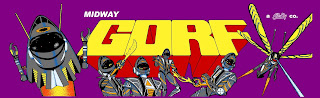
Gorf is a shoot 'em up arcade game by Midway Manufacturing that was designed by Jamie Fenton. It is one of the first, if not the first. games developed by a transgender woman. Gorf uses a lot from previous games in the genre, yet manages to remain a unique game on its own.

It contains five distinct phases. The first, Astro Battles, is based on Space Invaders. The second phase, Laser Attack, has dive-bombing ships, a ship that fires a single laser beam, and the Gorf robot. The third phase is named Galaxians and is obviously based on Galaxian, with ships in a formation similar to Space Invaders and ships that dive bomb at the player ship. The fourth, Space Warp, takes place in a wormhole where enemies fly out from the center of the screen and attempt to destroy the player's ship. The fifth, Flag Ship, is a battle against the enemy ship where a force field has to be broken before the floor of the flagship is shot through.

The game loops the five phases through six space ranks, each with increasing speed and additional enemy patterns. The ranks include Space Cadet, Space Captain, Space Colonel, Space General, Space Warrior, and Space Avenger. Once the five phases in Space Avenger are completed, the game remains on that rank but continues the loop.

Like other games of the time, such as Q-Bert, the sound effects are minimal but are amplified by the use of a synthesized voice. Like Q-Bert's backward speech, it is used here in a humorous manner. The voice will make insults and will make it feel targeted towards the player as it will say the current space rank as part of that insult.

Gorf is a game that is important to video game history for who made it, as Jamie Fenton was one of the first transgender female game designers. It was popular in its time, but it hasn't remained at the forefront of gaming history as the games that inspired it. This is a shame, as it is a fantastic game that has very different gameplay styles in each of the five phases. If you get a chance to play it, make sure to give this fantastic piece of arcade game history a try.

Final Verdict:
4½ out of 5

Monday, March 20, 2023

Shoot 'Em-Up Video Game Review: Parsec

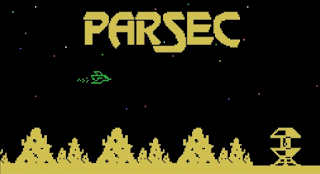
Parsec was an interesting horizontal shoot 'em-up video game that combined features of multiple arcade games into a single game. These elements actually worked well, making Parsec one of the most popular games by Texas Instruments.

Parsec was released for the TI-99/4A in 1982. The TI-99/4A was a computer released by Texas Instruments in June 1981. It was an upgrade of the 1979 computer known as the TI-99/4. Together, they were the first 16-bit computers released for the home market.

In 1981, Konami's Scramble and SNK's Vanguard were released into the arcade market. They were the world's first horizontally-scrolling shoot 'em-up games. Another game that was popular at the time was Atari's first arcade game with vector graphics, the 1979 arcade game Lunar Lander.

Texas Instruments took elements of these games, namely the horizontal scrolling of Scramble and Vanguard and the fuel meter of Lunar Lander, to create Parsec. Parsec had sixteen horizontal scrolling levels where a ship would have to shoot at enemy ships and avoid enemy fire as well as rocky terrain. There was also a fuel gauge which made it imperative to fuel the ship at regular intervals. This was accomplished by flying into a fueling tunnel.

One of the best parts of the game was a digitized female voice that acted as the ship's computer. This is optional, but the game is elevated from an average game to a cult classic because of it. The voice would let the pilot know when enemy ships and fueling tunnels are approaching, as well as a countdown that gives the pilot an idea of how long an asteroid belt would last.

Parsec is an excellent game for the TI-99/4A. On a computer that mainly had clones of other games, such as Pac-Man, Space Invaders, and Head On, it is great to have an original title. The combining of elements from Vanguard, Scramble, and Lunar Lander gave the game a unique flavor. The digitized computer voice alerting the player of danger and fuel tunnels rises the game to cult classic status. If you ever come across Parsec, I wholeheartedly recommend giving it a play.

Final Verdict:
4 out of 5