Showing posts with label maze game. Show all posts

Saturday, July 11, 2026

Arcade Maze Game Review: Pac & Pal


Pac & Pal is the black sheep of the Pac-Man series. It was primarily released in Japan, other than three hundred machines released to Europe as Pac-Man & Chomp Chomp, with Pac-Man's dog from the Hanna Barbara cartoon replacing the titular pal. It took the unpopular elements of Super Pac-Man and ran with them, making a game that is arguably the most polarizing in the entire series.

Pac-Man has to collect all of the items on the screen. Like Super Pac-Man, they are all locked behind doors. Unlike those games however, the doors are unlocked by collecting face-down cards scattered around the maze which will flip to reveal an item on the board. The game's titular pal, or the dog in Pac-Man & Chomp Chomp's case, is not much of a friend as they will attempt to steal the item before Pac-Man can get it and then take them to the ghosts where they will be out of Pac-Man's reach forever.

The weirdest part is that there are no power pellets here. If Pac-Man manages to collect an item, either before Pac-Man's pal Miru can collect it or by stealing it back from her, he will become larger and turn blue. This will enable him to turn the table on the ghosts trying to catch him. Unlike other games in the series, Pac-Man can not just walk into the ghosts. There is now an action button that will cause Pac-Man to emit a ray which will stun the ghosts temporarily.

Like Super Pac-Man before it, Pac & Pal contains stages with three levels each that then goes into a bonus stage. In the bonus stage, Pac-Man collects cards. The cards contain dollar symbols, Pac-Man's pal, or a ghost. If Pac-Man collects his pal, the final score is doubled. If a ghost is turned over before the end, the stage ends immediately. The cards are not randomized as they all have a pattern, so they can be memorized in order to provide the largest score possible.

This game does have one thing that this game, arguably, going for it compared to its predecessors. The game does not just have sound effects during gameplay, but actually has a stage tune that plays during gameplay. It is just one tune, so it can be repetitive, but it is a fun upbeat melody.

Pac & Pal is a weird game. Moreso than even Super Pac-Man, it takes all of the elements that made Pac-Man popular and threw them out the window. It takes the doors of the aforementioned title and makes them even stranger by locking them behind cards rather than keys. It adds a weird chase mechanic that ends up being kind of pointless other than point-wise as the game continues whether Pac-Man catches up to the items or not. If the pal ends up returning the item to the ghosts, it will still count as the item being removed from the board. It also strangely adds an action button for a ray power that Pac-Man had not had prior to this title. It is a strange game to rate, as it is not the best maze game out there, but it is definitely not like any other Pac-Man title. In any case, it is not a must play for fans of maze games or Pac-Man fans.

Final Verdict:
3 out of 5

Pac-Man Plus ReviewJr. Pac-Man Review Coming Soon

Friday, July 10, 2026

Arcade Maze Game Review: Super Pac-Man


The Midway Manufacturing Company licensed a conversion kit named Crazy Otto from General Computer Corporation to create Ms. Pac-Man, the first sequel to Pac-Man, the popular maze game it licensed for distribution from Namco. Six months later, Namco released its own sequel, Super Pac-Man. The latter was heavily overshadowed by the former, and for good reason, yet Super Pac-Man still remains a fascinating game in its own right.

While Ms. Pac-Man enhances the features that made Pac-Man such a fun game, Super Pac-Man deviates from the original by introducing features that weren't as well received by the general public, yet adds a new layer of strategy to the usual gameplay. It takes two non-essential elements from the original game and re-purposes them to make them part of the core gameplay. The first is keys, which were originally used as the most valuable of the items which granted bonuses in the original Pac-Man arcade game. Here, they unlock doors which are needed to collect all of the fruits in order to finish each level. The second is the giant Pac-Man form, which was originally seen as a joke sequence in a cutscene in the original game. This form allows Pac-Man to go through doors to eat the fruits within without needing the keys to unlock the door first.

The rest of the formula of the game is similar, yet noticeably different. Pac-Man needs to eat all of the fruits, rather than pellets, to progress. The fruits add points while the only pellets are now the larger pellets which give Pac-Man his larger super form and also allow him to eat the ghosts that chase him around the stage. When not powered up by the large power pellets, Pac-Man will lose a life upon being touched by a ghost.

There is another major difference. There are still three levels between stages, but the game doesn't have cutscenes between stages. Instead, there are now bonus stages in which Pac-Man has to clear a maze within the time limit while entirely in his large super form.

The sound effects from the original game return, along side new sound effects for the collecting of keys. The opening music also returns, albeit in a slightly faster and higher pitched form. The most memorable music of the original two games in the series came from the cutscenes, however, and without these the music is a bit lacking compared to the other games. The early 1980s Pac-Man games, however, were never were music-heavy due to the restrictions of their time, so this isn't too much of a loss.

Super Pac-Man is a game that takes most things about previous Pac-Man titles and tosses them out the window for something new. The basic eating and chasing mechanic is still there, making it feel familiar, but the addition of keys and the reduction of edible items due to the larger fruit graphics and fewer item placements makes it feel strangely unfamiliar at the same time. This makes it a bit of a less accessible title than its immediate predecessors, but it is still an excellent example of an arcade maze game that is well worth playing at least once.

Final Verdict:
3½ out of 5

Ms. Pac-Man ReviewPac-Man Plus Review

Thursday, February 12, 2026

Arcade Maze Game Review: Pac-Mania

Pac-Mania was the tenth video game in the Pac-Man series. It had a combination of factors that made it unique as it never was directly replicated following its release, so it this is a game retains its own place in the Pac-Man pantheon.

It was developed by Namco and distributed to arcades by Namco in Japan and Atari Games in North America in 1987. It followed the General Computer Corporation-developed maze arcade game Jr. Pac-Man from 1984 and the Namco-developed platform arcade game Pac-Land from 1984 that was based on the 1982-1983 Hanna Barbara animated television series

As the game that directly followed both of the aforementioned games, Pac-Mania included aspects from both of them. It included the scrolling mazes that were introduced in Jr. Pac-Man, but this time they scroll both horizontally and vertically. The larger mazes also allow the addition of more ghosts to the mix. The usual four colors return, with three more colors joining them. The traditional ghosts include the red ghost Blinky, the pink ghost Pinky, the cyan ghost Inky, and the orange ghost Clyde. Sue, the ghost introduced in Ms. Pac-Man as the orange ghost, is presented as purple.

As a platform game, Pac-Land was the first game in the series that allowed Pac-Man to jump. Even though Pac-Mania is a return to the maze genre, he has the ability to jump here as well. His jump is difficult to master as it is delayed and floaty by design, since it doesn't need the precision of platform game jumping. Once you get used to jumping, however, it becomes quite convenient to jump over ghosts that aren't activated as the standard edible blue after eating a larger power pellet. To counter Pac-Man's new jump ability, there are now two new ghosts. They are a green ghost named Punky and a grey ghost named Spunky. They are bigger than the regular ghosts, but it is still possible to jump over Punky if Pac-Man times his jump correctly. However, it is impossible to jump over Spunky.

The bonus items once again sit below the ghost gate as in the original Pac-Man. Most of these award the usual bonus points from fruits, but there are two special colored power pellets that give additional affects. If Pac-Man eats a red pellet, the point total for eating the ghosts will be doubled. If Pac-Man eats the green pellet, Pac-Man will temporarily receive a boost in speed.

Beyond the gameplay changes, the presentation also saw a stark change from previous games. The mazes are now laid out isometrically with a 2.5 dimensional presentation. Because the edges of the mazes can now be seen, the graphics make good use of this additional half a dimension. Mazes take on various shapes such as interconnecting Lego-like bricks, mazes that look like neon tubes, pyramid blocks, and cubes. The cutscene breaks also make a return, in a fittingly comical manner.

The sound also matches the upgraded visuals. The eating and dying sound effects are joined by jumping effects, but the standout is the music. Pac-Land had a pleasing loop of the Hanna-Barbara Pac-Man theme song, but this game gives some variety to match each of the levels. It's the pinnacle of sound design for the maze side of the Pac-Man sequels.  

Pac-Mania is a game that takes everything about previous Pac-Man titles and builds upon them. The 2.5D isometric graphics, fun sound effects, and pleasing music really make this game a joy to play. The jumping aspect leaves a bit to be desired, however, as it is not as responsive as those in the Pac-Man platform games. That's the only aspect that brings the score down a bit, but it's not enough to keep it from being one of the best Pac-Man maze games ever produced. 

Final Verdict:
4½ out of 5

Monday, February 2, 2026

Arcade Maze Game Shoot 'Em Up Compilation Review: Namco 20 Year Reunion: Ms. Pac-Man / Galaga - Class of 1981


To celebrate the twentieth anniversary of two of their most popular games, Namco released a cabinet that combined both of them on one printed circuit board. However, like automobiles, it was released in the year before the date listed. It's the release from September 2000, Namco 20 Year Reunion: Ms. Pac-Man / Galaga: Class of 1981.

Both of the games are sequels to popular games that improved upon their predecessors and became classics in their own right. Galaga is the sequel to Galaxian. It featured colorful bug-shaped enemies which had multiple forms of formations as well as attacks. The most unique part of this game was the enemy type which would beam the player ship up and away from the game area. If the player successfully destroyed the enemy, the captured ship would join the current ship to become a double fighter or triple fighter, depending on the amount of ships combined.

Ms. Pac-Man is the first sequel of Namco's popular Pac-Man. It expanded upon the original by having different maze shapes rather than just different colors and bonus fruit that would bounce along the maze rather than just sit in the middle. It was designed by General Computer Corporation as a Pac-Man conversion kit named Crazy Otto. The designers pitched the game to the company that held the American distribution rights to Pac-Man, Midway Manufacturing. Midway liked the game, purchased the rights, and worked with Namco to rework the game into a proper Pac-Man sequel.

This arcade compilation has the dubious reputation of setting off a series of lawsuits relating to the rights of Ms. Pac-Man. GCC claimed they were not paid the residuals that they were stipulated to earn in their agreement with Midway Manufacturing back in the 1980s. This led to a complicated rights battle that would become even more complicated after GCC was disestablished in 2015 and AtGames bought its rights to residuals for the games the former designed for Midway.

Ms. Pac-Man is now no longer included in Namco Museum and Pac-Man compilations, and the character of Ms. Pac-Man is now portrayed by other Pac women, the latest of which is known as Pac Mom. Because GCC also created Jr. Pac-Man, that character has also been replaced by Pac Boy. Midway developed Baby Pac-Man, so that character is now replaced by Pac Sis. It's a really odd situation that has resulted in retro games being edited in re-releases and remakes.

Class of 1981 also includes an awesome easter egg. It's one that I always use when I find the cabinet out in the wild, as even though I prefer Ms. Pac-Man, its fun to play a game not noted on the marquee. If you use a specific combination of joystick moves. If you turn the joystick up, up, up, down, down, down, left, right, left, right, left at the game selection screen, the red ghost Blinky will change into the pink ghost Pinky. Selecting Ms. Pac-Man will now play the original Pac-Man instead.

Namco 20 Year Reunion: Ms. Pac-Man / Galaga: Class of 1981 is a fun compilation of Namco maze games and shoot 'em ups, including Ms. Pac-Man, Galaga, and the hidden game Pac-Man. Arcade1Up also has a stand up machine and a countercade that has the name of this compilation, but it includes a different third game, or more in the case of the stand up cabinet because it does not include the Class of 1981 PCB. The games are classics that are still fun to play, and this is a great way to experience them if you ever come across the 20 Year Reunion arcade cabinet.

Final Verdict:
4½ out of 5

Saturday, January 24, 2026

Arcade Maze Game Review: Pac-Man Plus


Pac-Man Plus is a weird game. It is a conversion kit that acts as an upgrade for the classic arcade maze game Pac-Man

Two arcade games in the Pac-Man series were developed between the release of this game in 1983, not including the two Pac-Man pinball tables. Both Ms. Pac-Man by General Computer Corporation and Super Pac-Man by Namco were quite different than the original game. Pac-Man Plus, created by Bally/Midway, is simply Pac-Man with faster, more aggressive ghosts and some other tweaks.

The music and sound effects are identical between the original and Plus iterations. The part that makes this an upgrade, is, above all, slightly altered graphics in comparison to the classic game. The maze layouts haven't changed except for the fact that they are now green rather than blue. The ghosts are now shorter with closer set eyes, and strangely, now are apparently fruit since they have stems with leaves on their heads. On the subject of fruit, the items that appear periodically in the center of the maze have now been changed to other items.

The aforementioned items do have a use beyond a point bonus this time around. When they are collected, ghosts will become invisible signifying the ability for Pac-Man to chomp them up. If Pac-Man eats a ghost in this state, its point value is doubled. Pac-Man's other method of eating ghosts, the power pellets, now are a bit wonky. Occasionally, eating one will cause weird effects such as turning the maze walls invisible or only turning a maximum of three ghosts blue rather than four. The latter will lower the possible point chain and will disrupt the usual ghost pattern.

Pac-Man Plus is essentially nothing more than a more difficult game of Pac-Man. The graphics have been tweaked, though the music and sound effects are identical to the original. The biggest changes are the fact that the ghosts are faster and nastier. The ability of the bonus item to make ghosts vulnerable with double the point value is a welcome addition to clear the maze and rank up points. This is especially needed considering the weird power pellets which occasionally reduce the amount of ghosts that were turned blue, which in turn lowers the amount of points that can be collected. Pac-Man Plus isn't really a must-play compared to the first two Pac-Man games. It has been ignored by Namco and its licensees, undoubtably for this reason, until Arcade1Up began adding it to its lineup of games in some of its home cabinets. If you have access to it, give it a try, but there is no need to go out of your way to track this one down.

Final Verdict:
3 out of 5

Super Pac-Man ReviewPac & Pal Review

Tuesday, January 13, 2026

Arcade Maze Game Review: Ms. Pac-Man


Ms. Pac-Man was the follow-up to one of the most influential arcade games of all time. It had unquestionably large shoes to fill, but surprisingly it not only matched the brilliance of the original, but managed to improve upon it in big ways.

The story of the development of Ms. Pac-Man is fascinating. The Japanese developer Namco developed Pac-Man and distributed it in Japan, while Midway distributed it in North America. When the 1980 maze game became a worldwide hit, Midway was anxiously waiting for Namco to develop a sequel. In the meantime, a Massachusetts company known as the General Computer Corporation created a board set to upgrade Pac-Man to a game known as Crazy Otto. Midway liked the game so much that they signed a deal with GCC to purchase the game and to give the developer a portion of the residuals. Midway then had it revamped with artwork that hewed closer to the original and distributed it to arcades as Ms. Pac-Man.

GCC's game upgraded Pac-Man in a few notable ways. The original game had static maze layouts that merely changed color as the game went on, whereas Ms. Pac-Man has maze layouts that change alongside the colors. The bonus fruit also are no longer static in the middle of the maze under the ghost gate. They now bounce into the stage, travel along the mazes, and then bounce back out through the tunnel exits at the sides. A suitably throbbing heartbeat of a sound effect also plays when the fruits are on the screen. The game also has new cutscenes that involve both Pac people, and new cutscene music to match.

The ghost pathfinding artificial intelligence has also been improved, as their movement is less predictable and more random than in Pac-Man. This, combined with the fact that the ghosts can chase Ms. Pac-Man through tunnel exits, make the game more challenging. With a game as popular as Pac-Man, this was especially important as gamers had memorized the ghost patterns in the original game.

Ms. Pac-Man is a game that improved upon a game that was already a classic, and has since become a classic in its own right. With new ghost patterns, new maze layouts, and new cutscenes with new music, it a game that should be played at least once by every video game affectionado.

Final Verdict:
4½ out of 5

Monday, January 12, 2026

Arcade Maze Game Review: Pengo


Pengo is an arcade puzzle video game developed by Coreland and manufactured by Sega. It was released in 1982, which was a stacked year for arcade games. It might not be as remembered as many of the other games released in that time frame, but the game is as approachable as any of those games. 

The game is easy to pick up and play as the premise is simple. Pengo, a little red penguin, pushes ice blocks in order to eliminate fluffy multicolored birds known as sno-bees. Sno-bees will eliminate one of Pengo's lives if the two come in contact. If the block is near another, it breaks when Pengo pushes it, but if the space around it is clear, the ice will slide across the screen until it hits another ice block. This is the way the enemies are defeated, as they will get crushed if they are in the path of the block.

Pengo has to watch out for sno-bees. They can't push blocks, but they have other ways of attacking. They will become fast blobs if the player time on a level goes on for too long. More aggressive variants of these enemies also can break ice, leaving Pengo open to attack. As the game goes on, eggs will hatch from ice blocks, releasing the sno-bee inside. 

The game a fast-paced musical track that fits the game well. Actually, this is one of the cases where multiple versions of the game exist. The original release has Gershon Kingsley's 1969 hit Popcorn as the musical track, while later versions include an original track instead. I prefer Popcorn personally, as that track is popular for a reason. It is entertaining even in loops and sticks in your head long after you hear it. On the other hand, I can understand the licensing issues that would keep it out of most re-releases of the game. This isn't a case of music alteration that poses an issue like the music in Sonic the Hedgehog 3, however. Unlike some of the beta music in Sonic 3, the alternate track in Pengo fits the game just as well as Popcorn. It might not be quite as catchy, but it does sound good looped, which is important for these early games.

Pengo is an video game from the early years of arcades that does not deserve to be forgotten. It has a simple premise that allows anyone to pick it up, but because the enemies get more aggressive and employ new tactics as the game goes on, it takes a while to master. The graphics are also undeniably cute. The music is fast paced and works as a looping background track, whether it's Popcorn or Sega's alternate tune. If you enjoy Bomberman or arcade games like Dig Dug, you will have a fun time playing as the cute little red penguin.

Final Verdict:
4 out of 5

Sunday, April 23, 2023

Action Game Review: Super Bomberman


In 1993, Hudson Soft released a follow-up to its popular Bomberman action maze game with Super Bomberman for the Super Nintendo Entertainment System.

Super Bomberman takes what was best about Bomberman, including the mechanics of using bombs to blow up bricks and enemies. powerups for extra bombs and longer blasts, and level exit doors that can only be entered after all enemies are defeated. It then takes it a step further, with more enemies, stages taking place in themed worlds, more powerups, and boss battles.

It also has a fun multiplayer mode where up to four players, using the multitap accessory, try to blow each other up in a last Bomberperson standing battle royale. Not all of the players had to be human either, as there were optional artificial intelligence-controlled opponents for which you could set the difficulty level. Of course, it is infinitely more fun with at least one human opponent.

The graphics are fantastic, as they make great use of the capability of the SNES with bigger and more detailed player and enemy sprites and blocks compared to the original game. Atmospheric effects like fog also appear in some stages. The new enemies are all expressive, and even the balloon enemies from the first game look better here. The bosses are the highlight, as they are very detailed and extremely large, dwarfing Bomberman. This makes the stakes feel higher and gets the adrenaline flowing. 

Super Bomberman is a game that set the standard for the series, taking everything from the original game and adding lots more of its own elements that would become series staples. The larger roster of enemies, themed worlds, and bosses makes this game stand out from the originator. Plus, the multiplayer battles are loads of fun, making it a fun break from the usual story mode. If you enjoy Bomberman games, maze games, or just blowing things up, then make sure to give this one a try. It's a true classic.

Final Verdict:
5 out of 5

Monday, April 10, 2023

Arcade Maze Test Game Review: Dottori-Kun


In 1990, Japanese law required that all arcade cabinets had to be shipped with a working game so that purchasers could plug it in and immediately test whether the cabinet was functional. Thus, companies created simple games with cheap hardware that could be included and then disposed of by the purchaser. Taito created Mini Vaders, based on Space Invaders, for their EGRET candy cabinets. Sega created Dottori-kun as the game that was included with its Astro City arcade candy cabinets.

Like Taito, Sega also reached back into the 1970s for their test game. Dottori-kun was based on Head-On, a maze game released by Sega in 1979. Like Mini Vaders, Dottori-kun was a monochrome game with no sound and no score tracking. The buttons only change the color of the background and game graphics, although they still remain as tinted monochrome. Dottori-kun was never meant to be released commercially, but presumably, for the sake of completion, Sega Toys included it in its Astro City Mini video game console.

Despite the lack of sound and a score, Dottori-kun remains fun. As it is based on Sega's Head On, it is a game that combines maze games with automotive chicken. The goal is to collect all of the dots on the four rectangular-shaped roads. The hitch is that each road is only large enough for one vehicle and there is a computer-controlled racer zooming around the tracks in the opposite direction. There are splits in the roads at the center, so the trick is to grab the dots when the opponent car is on another road so that you can collect the dots and then turn onto another road so that the two cars aren't coming at each other head on.

Dottori-kun is an arcade game from 1990 that is a simplified version of the already simple 1979 arcade game Head On. Despite it just being a test game with monochrome graphics, no sound, and no score tracking, it still is remarkably fun. I'm glad Sega Toys included it in the Astro City Mini since this game doesn't deserve to be junked.

Final Verdict:
3 out of 5

Thursday, January 12, 2023

Arcade Maze Game Review: Heiankyo Alien


Heiankyo Alien is an interesting game. It's a maze game that predates Pac-Man that was created by the Theoretical Science Group of the University of Tokyo. It isn't a classic like Pac-Man, and the game doesn't have the grab-and-play mechanics of that game either. However, once the game mechanics are understood, it's enjoyable to play.

The game features a Heian-period police officer who protects the capital city by digging holes to trap aliens and then shoveling dirt on top of them. The gameplay is to dig a hole, lure an alien, and then fill the hole back up before the alien escapes and grabs you. Holes can be dug up to three times. The deeper the hole, the longer the alien stays in it. However, it also takes longer to fill the deep holes too.

I've heard about this game before, because of its historical significance as an early maze game. I hadn't had an opportunity to try it, however, until I picked up the PasocomMini MZ-80C. This console contains the original version of the game for the NEC MZ series. I can see why Denki Onkyō decided to adapt it for the arcade market, and why Sega/Gremlin opted to release it in North America.

It does have an arcade quality to it. Heiankyo Alien drops you right into the game. Without any knowledge of how the game works beforehand, it takes a while to get used to the mechanics. Once the mechanics are understood, it is mostly a fun experience, but the mechanics of the game are a bit wonky, and takes a while to get used to them.

Heiankyo Alien, without a doubt, is a game with historical significance. It is one of the first maze games, and it is fun once you get used to the mechanics. It doesn't reach the levels of the pinnacle of the genre, Pac-Man, as it's not a pick-up-and-play game with infinite replayability. However, if you are a fan of maze games, it might be worth playing.

Final Verdict:
3½ out of 5

Wednesday, July 6, 2022

Arcade Maze Game Review: Lupin III

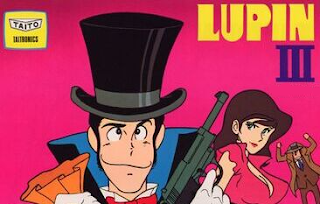
In 1980, Taito released Lupin III, the first video game based on the popular Lupin the Third manga and anime. It was developed on the same Intel 8080 hardware platform that powered Taito's classic Space Invaders. That game stood the test of time, but does Lupin III fare nearly as well?

I first came across Lupin III in 2001 while working on my arcade emulator, LASER. As it is a deceptively simple game, like all games on Taito 8080 hardware, I did not expect much of it. However, as I worked to get the graphics and controls working properly in my emulator, I began to see that it actually is very enjoyable.

It is one of the first maze games, as it was released three months before Pac-Man, the seminal game in that genre. The purpose of the game is to clear out all of the money bags from the bank while avoiding the police. Like most early maze games, once the screen is cleared, it keeps repeating at a faster rate until all player lives are lost. Like Pac-Man, despite sounding boring, it is a lot of fun in practice. This is especially true in the international version.

The original Japanese release was a simple affair as all characters were colored yellow and the game contained no sound. The international version had multiple colors for the various characters, stage music, a stage clear jingle, and messages when stages are cleared. It also replicated the intro in an expectedly simple, yet amazingly effective, style. This makes the international version quite fun to play, and, like Pac-Man, it is infinitely replayable.

The international version of Lupin III is available in the Taito EGRET II Mini console, making it available to the home market for the first time. Although it has simple gameplay mechanics and simple, yet effective, animations and sound, the international version is extremely replayable. It is one of my favorite games on Taito 8080 arcade hardware and it is well worth playing if you ever manage to come across it.

Final verdict:
3½ out of 5

Friday, January 1, 2021

Maze Game Review: Pac-Man Championship Edition

Pac-Man Championship Edition takes the well-known formula of Pac-Man and turns it on its head with a game focused on racking up the points rather than focusing on completing multiple stages.

Pac-Man is a veritable classic. It defined the maze game genre and became the king of arcades. Its formula has been copied and refined multiple times throughout the lifetime of the Pac-Man series, with my personal favorite remaining the ever-excellent Ms. Pac-Man.

The character has also been reinvented over the years, appearing in everything from adventure games, platformers, and kart-racing games, to name a few. However, Pac-Man is always at his best when he is eating pellets around a maze while keeping away from the pesky ghosts. It's a tried and true formula, and the formula of the maze games hasn't really changed much over the years. Pac-Man gets larger in Super Pac-Man and Pac-Man Jr.'s mazes scroll rather than remaining on a single screen. However, the way that the games are presented is largely the same.

Pac-Man Championship Edition changes the formula while maintaining the basic gameplay that made Pac-Man so popular in the first place. The maze stages are gone, and so too are the cutscenes. In their place are a timer and fantastic use of the fruit. The goal here is to eat all of the pellets on one end of the maze. Doing this causes fruit to appear on the other end of the maze. Eating that fruit causes the pellets on the other end to be replenished. This continues until the timer runs out or until Pac-Man has lost all of his remaining lives.

There is also an extra mode, which is my personal favorite. In this mode, the pellet gameplay remains the same, however eating all of the pellets on one side of the maze not only makes fruit appear but eating the fruit causes the entire layout of the other side of the maze to change as well. Pac-Man also quickly picks up speed in this mode, and so do the ghosts, making it much more exciting.

Pac-Man Championship Edition was originally released on Xbox 360 in 2007, so it has some modern flair. The mazes are presented in neon colors that light up when a ghost or Pac-Man comes near them. This happens while a pulsing bass line plays as the game's soundtrack. The game was successful for Namco, so it has since appeared on other systems, including the PlayStation 3, PlayStation Portable, iOS, and Android, among others.

An even more interesting port, however, is the official Famicom (the Japanese version of the Nintendo Entertainment System) version created by M2 and a Japanese coder known as Coke774. This version uses the Namco 163 chip, which gives the Famicom additional RAM as well as additional sound capabilities. The Famicom version of Pac-Man Championship Edition uses this chip to present a game that contains the same gameplay complete with a booming soundtrack, mixed with visuals that both mimic the ports on modern systems yet contain graphics from the original Famicom version of Pac-Man as well. This is pulled off excellently and is, by far, my favorite version of the game.

With a booming soundtrack, fantastic visuals, and addicting gameplay, Pac-Man Championship Edition is the best maze game in years. Any version is well worth your time, but I'd recommend the Famicom version over the rest. It has a great blend of classic and modern visuals and makes use of the Namco 163 chip to give the game the booming soundtrack that makes the presentation so special. The Famicom version is available in Namco Museum Archives Volume 1 and is well worth the purchase price for just Pac-Man Championship Edition alone.

Final Verdict:
5 out of 5

Saturday, October 5, 2019

Arcade Maze Game Review: Pac-Man


This review was adapted from the original that was posted at Jupiter Beagle on September 28, 2008.

Pac-Man is a true classic. Pac-Man’s pizza-bodied visage is often used as an icon for gaming itself. Everyone has probably played Pac-Man at some point in their life, or if they haven't they at least know about it.

The premise is simple. You control a round yellow dot with no eyes and a mouth that is constantly opening and closing. You have to navigate a maze and eat all of the round pellets on the board while avoiding the four ghosts who are constantly roaming the board looking for a Pac snack to eat. You can turn the tables on the ghosts by eating one of the four large power pellets. This causes the ghosts to temporarily turn blue. Now, the ghosts run away from you and you are able to eat them before the large dot’s effects wear off. 

In the original Pac-Man, many of the enhancements that Ms. Pac-Man brought to the table are not present. The layout of the mazes never changes and the food items that you can eat in each stage after collecting a certain amount of points always remain at the center of the maze. The emulated versions from the Xbox 360 onward are my favorite way to play the game. 

All of the addictiveness of Pac-Man is there as most emulated versions use the true arcade version of Pac-Man. Thus, all of the tricks that can be pulled off in the arcade version can be pulled off in these versions. For anyone who loves Pac-Man but isn’t too good at it, there are tricks in the emulated versions that are not present in the originals. In some emulated versions, you can start from any stage in the game after you complete it once, and in other emulated versions you can rewind a mistake to try it again. 

Arcade purists may not like the fact that these emulated versions often have unlimited continues, but there were versions of Pac-Man in the arcades that had unlimited continues as well. In the Ms. Pac-Man/Galaga Class of 1981 arcade game, Pac-Man can be unlocked by entering up, up ,up, down, down, down, left, right, left, right, left at the game selection screen and then choosing Ms. Pac-Man after hearing a series of dings letting the player know the code was inserted correctly. This version allows unlimited continues as well. The only difference is you have to enter a quarter every time you wish to continue. 

On the subject of achievements in the latest console versions, Pac-Man typically has plenty. In the Xbox 360 version, each fruit or item in the mazes gives you another achievement. If you go for all of them, you will be able to see each of the game’s cutscenes, which were one of the main draws of the game in the arcades when it first came out. The cutscene music is so catchy that it’s sure to stay in your head for quite some time. There are only three cutscenes in the original Pac-Man, and they all show the comeuppance of the ghosts in various humorous ways. 

There are three achievements in the Xbox 360 version, in particular, that are a little more challenging. One requires you to eat all four ghosts in the stage, while the other, harder, achievement requires you to eat all four ghosts all four times in one stage. The latter is quite hard, and all but the most diehard Pac-Man fan should find this one a challenge. 

The other difficult challenge in the Xbox 360 version requires you to get to level 21. After you get to a certain point in the game, the large dots no longer turn the ghosts blue, and the ghosts merely turn around when you eat it. Thankfully the feature offering unlimited continues is there for those of us without super Pac-prowess, so it’s not an impossible task. 

In the end, the decision of whether to play Pac-Man rests on how much you like arcade maze games. Though, if you do, I’d say it’s worth the play even if you are a casual fan of the genre. 

Final Verdict: 
4 out of 5