Showing posts with label beat 'em up. Show all posts

Sunday, February 22, 2026

Arcade Beat 'Em Up Review: Nekketsu Renegade Kunio-Kun


Nekketsu Renegade Kunio-Kun, later localized as Renegade in the West, is an arcade beat 'em up by Technōs Japan. It was the game that started the series that known as Kunio-kun in Japan and primarily known as River City in the West.

The story of the game is simple. Kunio-kun is a new student at Nekketsu High School. The name of the school is a reference to the attitude of Kunio himself, as it translates to passionate, courageous, or hot-blooded. There is a student there who is always bullied named Hiroshi, whom Kunio befriends as he can't stand bullies. When Hiroshi is kidnapped, Kunio goes off to rescue his friend.

Kunio fights various stereotypical Japanese gangs as he progresses in his quest to save his friend. He has to clear six areas of gang members and fight a boss before he can move on. The first area is at the train station at Shinjuku. He fights members of a rival high school, Hanazono, which literally translates into English as flower garden. The boss fight there is Kunio's rival Riki. The second area is at the seaport in Yokohama. He fights against members of the Yokohama Funky bōsōzoku gang, which is a youth culture in Japan that is into customized motorcycles. The boss fight here is against the gang's leader Shinji. The third area is a dark alley near a disco store. Here, Kunio fights girls from Taiyō Academy. The final fight here is against the Misuzu, the sukeban, or boss girl. The final area is at a car dealership that is a front for the Yakuza crime organization known as the Sanwakai, or Sanwa gang. Riki is freed after Sanwakai's leader, Sabu, is defeated.

The original arcade game didn't quite have the cute super deformed style characters that the Kunio-Kun games would become known for once they were brought to the Family Computer. The sprites have more colors and are taller than their 8-bit console counterparts, but they did share a lot of the style in terms of the anime-inspired sprites and exaggerated facial expressions.

What it did have in common with the rest of the Kunio-kun brawling games and its spiritual successor, the Double Dragon series, was its fantastic beat 'em up gameplay. Kunio has the ability to jump and to perform a multitude of moves using only two action buttons and the right and left direction on the joystick. There are actually a whole range of actions he can make with such a small amount of buttons, a running hook, a jump kick, a collar grab, a knee bash, and a shoulder throw. He can also perform a beat down on enemies and defend himself when grabbed. The limited amount of buttons actually made this a perfect game to port to the Famicom, which is where the Kunio-kun series really flourished.

The music in this game is fast-paced which fits the action perfectly. There are sound effects for things such as hitting and kicking. There are a few compressed voice clips here, including a female Japanese announcer at the game's start as well as sounds of exertion from Kunio and screams from the enemy fighters. It's all a fantastic mix of audio, especially at the time of its release in 1986.

Nekketsu Renegade Kunio-Kun is notable as being the premiere of the Kunio-kun series, which is still going strong today. Beyond that, it remains enjoyable despite its sharp difficulty, which was common in arcade games of the time. The modern re-releases that use emulation are a great help here, as this type of gameplay isn't as popular as it was then and the ability to save a state and replay it makes it a lot more palatable. Later games, such as Double Dragon and Kunio-kun's own River City Ransom take the formula and improve upon it in big ways, but it is still interesting to see where everything began.

Final Verdict:
3½ out of 5

Wednesday, February 18, 2026

Arcade Beat 'Em Up Game Review: X-Men


X-Men is an arcade beat 'em up from 1992. It is one of approximately ten arcade games in that genre developed by Konami in the 1990s

It is the only video game which has character designs based on the animated pilot X-Men: Pryde of the X-Men. The playable character roster includes Cyclops, Colossus, Wolverine, Storm, Nightcrawler and Dazzler. The fact that the character designs are taken from the Pryde pilot actually works well for the game because those designs were based on some classic art from the comics, albeit sometimes in different colors such as Dazzler's jacket being brown instead of blue. Some of the designs are great for comics fans, such as Wolverine in the brown and tan colors given to him by the Marvel Comics artist John Byrne.

As is usual for Konami beat 'em ups of the era, the sprite work is superb. The pixel art really does resemble its source material to a tee. The animation is great here, with expressive movements that bring each Marvel hero to life as well as the animated series it is based on. The backgrounds are also well designed, perfectly bringing the world of the X-Men to the pixelated world of 1990s arcade games.

The music was always excellent in the classic Konami arcade games, and X-Men is no exception. The music captures the atmosphere of the Marvel universe fantastically. The sound effects also compliment the music. They also fit into the game world well, as they range from the mundane fight sound effects to futuristic sounds when the game veers from comic logic into science fiction territory, which is often.

The plot is simple. The X-Men have to defeat their archenemy, the master of magnetism, Magneto. He is once again trying to upend human civilization and is sending many mutants that are on his side after the X-Men. There are many classic X-Men villains that appear in this game. The villains that appear the most due to their non-human nature are the mutant-hunting robots known as the Sentinels and the X-Men-hating cyborgs known as the Reavers. The former should be familiar to most X-Men fans as they appeared in one of the best X-Men movies produced by 20th Century Fox, X-Men: Days of Future Past.

Other enemies that appear in the game are classic X-Men villains. Many should be familiar as they have appeared in various X-Men films. These mutants include Mystique, Pyro, Blob, the White Queen Emma Frost, and Juggernaut. The small Sentinels in X-Men: Days of Future Past were based on the nearly indestructible Sentinal-descendant known as Nimrod from the comic of the same name. He appears in the game in his full glory. The other villains never appeared in the films, but they have crossed the paths of the X-Men in the comics many times. These two villains are the Living Monolith and Wendigo.

Although he isn't a playable character, the benefactor of the X-Men, Professor X, appears in the game when he is kidnapped by Magneto. As it is based on the Pryde of the X-Men pilot, it's only natural that when Charles Xavier is captured, Kitty Pryde would be captured as well. This culminates in a tense final boss battle against the master of magnetism himself.

X-Men is a fantastic arcade game that brings the world of the X-Men circa the 1990s to life in a bombastic fashion. Although the Pryde of the X-Men animated television pilot was never picked up for a full series, the choice to use the character models for the game was a wise decision. The pilot had looks for the X-Men that were pulled from classic comics but were rarely seen outside of them, including Wolverine's classic brown and tan suit. As an X-Men fan, it was fun to see these designs in action in a video game. The sprite and background art are fantastic, the music and sound effects are top notch, and the beat 'em up formula is Konami at its best. Any fan of arcade beat 'em ups owes it to themself to try this game at least once. It's truly astonishing.

Final Verdict:
4 out of 5

Wednesday, April 26, 2023

Beat 'Em Up Game Review: Teenage Mutant Ninja Turtles III: The Manhattan Project


Teenage Mutant Ninja Turtles III: The Manhattan Project was a beat 'em-up video game for the Nintendo Entertainment System based on the 1980s animated television series.

It has the craziest storyline of all the Konami games based on the Teenage Mutant Ninja Turtles. However, since the 1987 series was so zany, it fits with the franchise perfectly. In the game, Shredder and Krang stole the entire island of Manhattan and it is up to the ninja turtles to get it back.

As it is for the Nintendo Entertainment System, it only has two action buttons. However, it makes great use of what is available. It manages to have most of the moves from the arcade games thanks to button combinations. It also pushes the Nintendo Entertainment System to its limits. It has the fun enemy animations and background object interactions from the arcade games that weren't present in the NES version of the original arcade game. It lacks the ability to have different kinds of enemies on screen at a time, but since the enemies have a ton of character, it's not that noticeable while playing through the game.

The game also has quite a nice soundtrack that evokes the feeling of the arcade games. It also has voice clips, but, of course, they are highly compressed due to the limitations in file size available on NES ROM cartridges. This was pretty standard practice at the time, and voice clips weren't common on the NES at all, so it's cool they're included. It really does help to evoke the feeling of the Konami arcade beat 'em ups.

Teenage Mutant Ninja Turtles III: The Manhattan Project is a worthy member of Konami's 90s ninja turtle beat 'em up oeuvre. When I was a little girl, I avoided the NES Teenage Mutant Ninja Turtles games due to the small size of the sprites and backgrounds necessary for the games to fit in the small resolution of the console. This was a mistake on my part, as Konami managed to translate all of the gameplay, style, and charm from the arcades into Nintendo's little grey box. If you are going to play this, and you should, opt for the Teenage Mutant Ninja Turtles Cowabunga Collection. That way you can reduce the flickering that was necessary to push the console to its limits. That's one of the great things with emulation, we have much stronger hardware now, so we don't have to live within those limits anymore and can experience games at levels the developers could only have dreamt of back in the 1990s.

Final Verdict:
4 out of 5

Saturday, April 1, 2023

Arcade Beat 'Em Up Review: The Simpsons


The Simpsons is a beat 'em-up arcade developed and manufactured by Konami early in the run of The Simpsons television series.

The plot is fairly simple but works well. Waylon Smithers broke into a jewelry store and stole a diamond for Mr. Burns. He crashes into the Simpsons, the diamond pops into Maggie's mouth in place of her pacifier and Smithers takes the diamond, Maggie and all.

Players can take control of any of the remaining four main Simpsons family members. Marge smacks thugs with a vaccuum cleaner, Bart whacks enemies with his skateboard, Lisa whips baddies with a jump rope, and Homer just uses his fists and feet. A devestating attack can also be accomplished when two players combine forces, resulting in the duo spinning around to offer an enhanced attack on enemies.

There are eight levels total, including Downtown Springfield. Krustyland. the Springfield Cemetery. Moe's Tavern. Springfield Butte at the Springfield National Forest, Dreamland, the Channel 6 Station building. and the Springfield Nuclear Power Plant. Each of the levels includes generic Simpsons-style men as enemies, but also include level-specific enemies such as Bigfoot, flying saxophones, and ninjas, among others.

The bosses include characters from the show such as the wrestler Professor Werner von Brawn, a Krusty the Clown balloon, a bear that looks like the one that befriended Maggie, and of course, Smithers, and Mr. Burns. It also includes characters created for the game such as a large goon and his child-size henchman, a fire-breathing drunk, a sentient bowling ball, an electric-shooting robot, and a kabuki warrior.

Konami did a fantastic job with the graphics, as both the characters and the backgrounds look just like pixelized versions of the art from the show. The music is also fantastic, including a digitized version of the classic theme song as well as stage music that wouldn't be out of place in the show proper. There are also samples of vocal clips from the show's characters.

Konami was the king of arcade beat 'em ups in the 1990s, and The Simpsons ranks among their best. Since it was released early in the show's run it includes some oddities such as a much eviler Mr. Smithers than usual, and deeper voices for Smithers and Mr. Burns than usual. All of that aside, it is still a fantastic beat 'em up arcade game that should be played by everyone at least once.

Final Verdict:
4½ out of 5

Tuesday, March 28, 2023

Arcade Beat 'Em Up Review: Battletoads


Battletoads was tough as nails on the Nintendo Entertainment System, but by the time the toads came to arcades, their game became a lot more balanced and a lot more fun.

The game was developed by Rare, but it plays a lot like a Konami arcade beat 'em up such as Teenage Mutant Ninja Turtles: Turtles in Time. This is fitting considering Battletoads originated as a Ninja Turtles homage.

Battletoads has nice, large detailed sprites for both the toads and the enemies. It also has some fun with the format by having the enemies occasionally thrown toward the screen when defeated.

Like many beat 'em up games, to shake things up a bit from the usual walking and beating up of enemies, there is also an elevator level with the stage moving vertically as the enemies come in from the sides.

The game is not any more difficult than a Konami beat 'em up. It can be played through to the end easily since adding a credit continues right where the game left off. In the era of emulation that won't cost you a large chunk of quarters to do so.

Battletoads is a fun, colorful beat 'em up arcade game. The game isn't punishing like the console game of the same name, as it plays a lot like a Konami arcade beat 'em up. It's a shame that this one isn't as remembered as the console Battletoads, but its inclusion in the Rare Replay compilation at least makes it easily available to players new and old.

Final Verdict:
4 out of 5

Friday, March 17, 2023

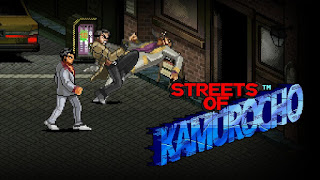
Free Endless Brawler Review: Streets of Kamurocho

To celebrate its sixtieth anniversary in 2020, Sega released several small free games for Windows through Steam.

One of the smallest, yet also one of the most interesting, was Streets of Kamurocho. This game was an endless brawler that mashed together two of Sega's most well-known series, Streets of Rage and Like a Dragon, in a satisfying way.

The game remakes the first level of the Sega Genesis classic Streets of Rage 2 with background graphics and character sprites modeled after the original Yakuza. The game begins with a cutscene, told in 16-bit style still frames, which retells the plot of Yakuza. Kiryu goes to prison for a crime committed by his friend Nishikiyama. When he gets out of prison 10 years later, Nishiki has changed, becoming bitter and jealous of Kiryu and intending to become the next chairman of the yakuza organization known as the Tojo clan.

The player characters are either Kazuma Kiryu or Goro Majima, and Ichiban Kasuga can be unlocked. These characters have sprite sheets that resemble their 3D forms, however, they all have the same move set.

The game is an endless brawler in that the same level just repeats with a harder difficulty until the player runs out of lives, with the goal being to get the highest score. It's basically just a fun concept that was thankfully released completely for free. Due to its simplicity, it isn't more than a fun curiosity. However, because it is free, looks great, and has tight controls, it is worth playing, at least for a little bit, to see what might have been had a full Streets of Rage meets Like a Dragon spin-off ever released.

Final Verdict:

3 out of 5

Yakuza Kiwami ReviewYakuza 2 (HD) Review

Tuesday, March 7, 2023

Arcade Beat 'em Up Mega Review: Teenage Mutant Ninja Turtles - Turtles in Time

Teenage Mutant Ninja Turtles: Turtles in Time was the second, and arguably, the best, arcade game by Konami to feature the pizza-eating ninja turtles.

Teenage Mutant Ninja Turtles features a wacky plot that fits right into the 80s iteration of the franchise. The mutant from Dimension-X, Krang, stole the Statue of Liberty and the nemesis of the turtles, Shredder, mocked them on live television to get them to come after them. Once the turtles get there, they are sent through a time vortex. The turtles get flung back and forth through time as they fight their way through the past, present, and future until they get back to their own time and stop Shredder's crazy plot.

The turtles have to go through nine levels, or ten in the Super Nintendo Entertainment System version since the first visit to the Technodrome was omitted in the other versions. The levels range from the sewers, alleys, and New York City streets in the present, to prehistoric times with stone warriors and dinosaurs, to a pirate ship in the golden age of piracy, to the western United States in the Wild West era, to hover transport areas in the future, and then finally to a space station and the Technodrome for the final fight.

Konami was the leader when it came to arcade beat 'em ups in the 1990s, and this game shows that in spades. The game has satisfying kicking, punching, and jumping moves and items that can be interacted with in the environment. It has excellent animation, from the turtles, to the foot soldiers, to all of the enemies throughout time. The backgrounds are probably the best two-dimensional art that Konami has ever produced, which is saying something for a company that was so prolific in the golden age of arcade games. The art really gets you invested in the game, as each location is highly detailed and makes you feel like you are really in those time periods.

The arcade version of Konami's original arcade game was the best version with the Nintendo Entertainment System version being only for those who were interested in the extra levels. It's harder to say this time around. The Super Nintendo Entertainment System version only supported two players rather than four, and lacked some animations and voice samples compared to the arcade version. The SNES version also has an exclusive Technodrome level and a fun battle where the object is to chuck foot soldiers toward the screen. Both versions have the Neon Night Riders level, but the arcade version has a straight-forward horizontal battle on hovercraft whereas the SNES version makes extensive use of the mode 7 effects of the system to make the level an over-the-shoulder battle. The arcade version has nine bosses. The SNES version has those bosses as well, with the exception of Cement Man who is replaced with the Rat King. However, the SNES version also has Slash, fan favorites Bebop and Rocksteady, and a stronger iteration of their main foe that goes by the name Super Shredder.

There are also no-longer-available variations of the arcade version of the game through emulation as a stripped-down bonus in Teenage Mutant Ninja Turtles 3: Mutant Nightmare for the GameCube, PlayStation 2, and Xbox, as well as a remake titled Teenage Mutant Ninja Turtles - Turtles in Time Reshelled. The remake isn't worth tracking down, as it lacks the SNES extras and the three-dimensional graphics don't bring across the fun animations as well as the original two-dimensional pixel graphics. 

Teenage Mutant Ninja Turtles: Turtles in Time is a seminal arcade game. Great, responsive combat, excellent animation, fun enemies, and enjoyable boss levels make the game still fun to play thirty years after its original release. Both the SNES and arcade versions have their own qualities that make which version to play a matter of personal preference. Personally, I'd pick the SNES version for the extra bosses, the replacement of Cement Man with the more recognizable Rat King, the great use of mode 7 effects, the extra level, and especially the fun boss fight that has turtles chucking foot soldiers towards the screen. The best way to play this game is in the Teenage Mutant Ninja Turtles: Cowabunga Collection as it has both the arcade and SNES versions of the game so you can decide for yourself which is your preferred version to play.

Final Verdict:
5 out of 5

Fall of the Foot Clan ReviewTeenage Mutant Ninja Turtles II Review Coming Soon

Wednesday, September 21, 2022

Arcade Beat 'em Up Mega Review: Teenage Mutant Ninja Turtles


Teenage Mutant Ninja Turtles was an arcade game by Konami that was one of the premiere beat 'em ups when it was released in 1989. It still holds up today, especially in the newer releases that have multiplayer support over the internet.

As is common in arcade games, the story is scant, but it does get the job done. The goal of the game is to save your friends from the Foot Clan, then track down the Technodrome to defeat Krang and Shredder. The Nintendo Entertainment System version also adds a level where you have to shut down a weather machine that has been covering New York City with snow and another level where you fight a shogun in a martial arts dojo. 

Alongside the Foot Clan ninjas, Shredder, and Krang, there are also popular villains from the 1987 Teenage Mutant Ninja Turtles animated series, such as Bebop, Rocksteady, and Baxter Stockman. It also includes the lesser-known villain, Tragg the rock soldier. The Nintendo Entertainment System version of the game also includes two bounty hunters created specifically for the game, Shogun and Tora. 

Other than the fighting gameplay which feels responsive and easy to learn, the presentation is what makes this game unforgettable. It has fun character animations, both in the sprites of the turtles and those of the enemies. Two of my favorites are the animation played when one of the turtles falls down a sewer hole and those of the motorcycle-riding Foot Clan ninjas. The Nintendo Entertainment System Version has smaller sprites and simpler backgrounds, but it surprisingly includes most of the animations from the arcade version. The NES version also has two exclusive levels, the aforementioned snow-covered New York City and a level in a dojo. These levels, especially the dojo level, have some fun animations of their own including ninjas jumping up through the floor and the tiger painting that comes to life and fights the turtles. There is some slowdown,  flickering sprites, and only one type of enemy on screen at the same time in the NES version. However, it is really impressive how Konami managed to recognizably replicate the arcade version and add extra levels on such limited hardware. Digital Eclipse's emulation in the Cowabunga Collection is the best way to play the NES version, as it has options to remove most of the flicker and slowdown. 

The chiptune music is great, and it is fun that the catchy opening song is included in a sample that isn't compressed too badly. The voice samples, however, are more heavily compressed. This is fine for the electrocuting robots that channel the Daleks from Doctor Who by saying "do not resist us". The heavily compressed samples for the turtles such as "shell shocked", April's "save me", or Shredder's "tonight I dine on turtle soup" sound quite tinny and aren't as impressive as they once were. The NES version doesn't have any samples and does play a few different level songs as well as those from the NES exclusive levels, but the arcade game's music that is there has transferred quite well to the little grey toaster that could.

The arcade version has support for up to either two or four players playing simultaneously depending on the cabinet. The NES version only has support for up to two players playing simultaneously. The arcade version has unlimited continues. When I was a little girl, I went to an arcade with a pocket full of quarters. I probably paid a good ten dollars in order to get to the end. Like a lot of arcade games of the era, the ending is presented entirely through text. The text is fitting, however, and it has the same tone as the television series on which it was based. The NES version is harder, as continuing in the arcade version continues right where it left off while continuing in the NES version starts from the beginning of the current level. There are also only three continues in the NES version, although this can be changed to ten in the Cowabunga Collection. In the aforementioned collection, there is also a god option that makes the chosen turtle invincible and kills most enemies with one hit.

In addition to the arcade and NES versions, there were also versions for home computers such as Amiga, Amstrad CPC, Atari ST, Commodore 64, and DOS. There are a lot of limitations in these versions, and the controls feel a lot stiffer on each, so they aren't really worth playing. The arcade version, either in the arcade or via the emulated versions in the now-unavailable Xbox 360 version or in the Cowabunga Collection, is the best way to play this game. The emulated versions have online play, so if you enjoy multiplayer games, these versions are the way to go.

If you are interested in playing the additional two levels in the NES version, the control is just as responsive as the arcade version, so could be worth playing if you aren't turned off by the limitations of the older hardware. The best way to play the NES version is with the settings that mostly eliminate the flicker and slowdown in the Cowabunga Collection.

The Teenage Mutant Ninja Turtles arcade game is a bonafide classic that manages to hold up well to modern tastes. The fun animations, great chiptune music, and excellent level design make this one a must-play for Teenage Mutant Turtle fans as well as those who are fans of arcade beat 'em ups. The arcade version is the best version to play, but the NES version is fun if you are interested in the two exclusive levels. The Cowabunga Collection is the best choice to play as it includes both the arcade and NES versions and it sports accurate emulation, online play, and the ability to reduce slowdown and flickering on the NES version.

Addendum October 8, 2025: There is also an arcade version for the PlayChoice-10. This version is identical to the NES version, except there is a time limit in place where the game will quit when time runs out.

Final Verdict:
4½ out of 5

Teenage Mutant Ninja Turtles ReviewTeenage Mutant Ninja Turtles: Fall of the Foot Clan Review