Showing posts with label billiards. Show all posts

Friday, October 31, 2025

Open World Action RPG Review: Yakuza Kiwami

Before the release of Yakuza 0, Yakuza was the beginning of Kazuma Kiryu's story. Yakuza 0 proved to be one of the best games in the whole series. With the release of Yakuza Kiwami, which brought the game up to modern standards yet kept the core story intact, the original Yakuza actually holds up quite well.

The game begins in 1995, seven years after the events in Yakuza 0. Kazuma Kiryu, a twenty-seven-year-old member of the Dojima family within the Tojo Clan, has climbed the ranks within the clan. He is just about to become the patriarch of his own family when he takes the blame for the murder of Patriarch Shimano, although he was not the one that killed him.

Ten years later, Kiryu is paroled and he is released from prison. He now has to deal with members of the Tojo clan that want him dead, as well as the usual violent thugs that wander around Tokyo's Kamurocho district. A decade in prison has made his skills rusty, so he has to gain experience so that he can regain his former strength.

In the Kiwami remake of the game, Goro Majima, the Mad Dog of Shimano, vows to help him restore his strength so that he can battle him properly. This is called "Majima Everywhere", and the name is apt since the battles take place all around the city. This is simultaneously both the funniest and the most frustrating part of the remake since Majima will pop up from just about anywhere at any time. The best way to handle this is to keep leveling up, especially health and beast style moves. Defeating Majima will add moves to Kiryu's dragon style. and other than learning moves from Master Komaki, is the only way to do so. Like Yakuza 0, Kiryu can use the aforementioned beast and dragon style move set. Kiryu can also use moves in his brawler and rush styles. Each of these styles can be accessed by pressing a direction on the directional pad.

Kiryu's story picks up steam when he comes across a young girl, Haruka, that is somehow tied to the one billion yen that has been stolen from the Tojo clan. The Kiryu saga of the Yakuza franchise has always been about family, and that is true here as well. Yakuza 0 had Kiryu protecting his adopted father, Shintaro Kazama, and his sworn brother, Akira Nishiyama. Yakuza picks up that trend, as Kiryu does everything he can to protect Haruka, the little girl that ended up in his custody.

In Yakuza Kiwami, the Japanese voices are left in the western versions, but in the original western release of Yakuza for PlayStation 2, the English voices were dubbed by famous voice actors. It pains me to recommend the Japanese voices, as the English cast was amazing. Among others, it included Mark Hamill giving Joker vibes as Majima and Bill Farmer doing his best Sam the Canine Shamus as Detective Date. The English voices are actually really good. It's just the janky script that let them down. Not only is the dialog in the original English PlayStation 2 version clunky. but names of places and people have been shortened or even changed for little reason. To this day, no one but the translator knows why the Florist of Sai was given the name of Kage in English. He certainly never received a given name in the original Japanese version. Thankfully, Yakuza Kiwami has a much less awkward translation with the original names intact.

In the original Yakuza, the minigames were regulated to the UFO catcher, visiting with cabaret club hostesses, hitting baseballs at the batting center, blackjack, pachinko slot, and roulette. Yakuza Kiwami keeps the UFO catcher, batting center, blackjack, and roulette and removes the pachinko slots as well as four of the six hostesses. However, it adds minigames from Yakuza 0, including billiards, bowling. cee-lo, cho-han, darts, a karaoke button-based rhythm game, koi-koi, mahjong, oicho-kabu, Pocket Circuit slot car racing, poker, roulette, and shogi. The Sega game centers in Yakuza Kiwami also contain Battle Bug Beauties: MesuKing,  based on the Catfight Arena from Yakuza 0.

All of the minigames are fun diversions, but the best part of any Yakuza game outside of the main story is the side missions. There are many sidequests, and Yakuza Kiwami thankfully doesn't remove any sidequests from the original. Kiwami also adds a few new ones to tie the game back to Yakuza 0. Like any Yakuza game, some of them can be quite off-the-wall hilarious. There's nothing like the adult baby gangsters seen in later games, but the wackiness the series is known for definitely started here. As with any Yakuza game, the last side mission is an extremely hard fight with a member of the Amon family.

Yakuza is a great game regardless of which game you are playing, even if it is the PlayStation 2 version or the Japan-only Wii U and PlayStation 3 high-definition versions. However, the best way to play is definitely the Kiwami remake. It does remove 2 out of 6 hostesses and the pachislot games, however, it adds 12 minigames, adds three fighting styles, and brings the presentation up to modern standards. In doing so, it restored the original game's status as one of the best games in the series.

Final verdict:

4 out of 5

Yakuza ReviewStreets of Kamurocho Review

Tuesday, February 21, 2023

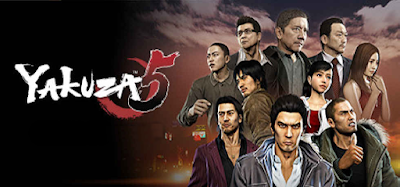
Open World Action RPG Review: Yakuza 5 (Remastered)


Yakuza 5 takes the idea from the previous game in the series, that of additional player characters, and bumps the number up to five, mirroring the game's title. 

The protagonists this time around include three from the previous game, Kiryu Kazuma, Shun Akiyama, and Taiga Saejima, It also includes a new character, the Kineicho nightlife reporter, Tatsuo Shinada. For the first time, the Like a Dragon series has a playable female character, none other than Kiryu's own adopted daughter, Haruka Sawamura. She doesn't fight, instead, she dances and sings her way across Sotenbori on her path to becoming an idol.

The game's plot involves, as always, a plot that involves the Tojo Clan and brings Kiryu reluctantly out of retirement. He does earnestly try to stay retired in this game, though. He is working as a taxi driver in Nagasugai under the pseudonym Taichi Suzuki. As he shares his name with an orphan at the orphanage he managed, I wonder if he chose that name because of him. As he's the one that is a fan of fighting, it's possible that he sees himself in the boy. If that is the case, that's heartwarming and makes me like Kiryu as a character even more.

The events that pull Kiryu from his taxi driving job are definitely strong enough to make Kiryu shed his relative anonymity. The sixth chairman of the Tojo Clan, Daigo Dojima, is missing and the Omi Alliance is believed to have nabbed him. If this was the case, it would bring the Tojo Clan and the Omi Alliance into a full-out war, which could bring collateral damage to civilians, including those that Kiryu cares about most.

The first four main characters are all fighters with their own style. Kiryu and Akiyama retain the style of fighting from the previous game. Kiryu is a good all-around fighter and Akiyama is fast with his feet. Shinada is a great grappler. Saejima thankfully gets an upgrade. While he is still strong as a tank, he no longer moves like one. His quicker moves mean that he's no longer a liability when enemies attack in groups, which happens a lot in the Like a Dragon series.

My favorite storyline and play style is Haruka's. She dances and sings through quick time events, but they are somewhat forgiving in terms of timing and are lots of fun. She also has jobs to do as an idol, including meeting fans and appearing on game shows. The best part about her story is that the animation of Haruka and her competitors is excellent, and is definitely among the series' best. The bonus is that her songs are actually great and definitely could be part of an idol's repertoire.

After Saejima escapes from prison, again, he finds himself in a small village in the mountains and must hunt to get the villagers to warm up to him. This leads to a fun hunting minigame. I never thought that there would be hunting in a Like a Dragon game, or that I would like it. But, it is definitely there and I actually really do enjoy it. It's a shame his exclusive city, Tsukimino, isn't as approachable as the small village due to it having way too many invisible walls. It's annoying, but the always weird and wacky sidequests made me able to ignore them after a while.

I finally see why Saejima is liked by many fans. He was as personable as plywood in the previous game, but he's actually likable here. In some parts, especially when interacting with the villagers in the snowy village, he even comes across as cute. With Haruka's dancing minigames and Saejima's hunting, Yakuza 5 has the most variety of any mainline game in the series up to this point.

Yakuza 5 is my personal favorite. The storyline is interesting, the characters are enjoyable, and Haruka's climb up the idol ladder is a great break from the usual gameplay the series was known for, at least at this point. The only drawback is the major city in Saejima's story has way too many invisible walls. If it weren't for that, the game would be nearly perfect.

Addendum February 22, 2013: I forgot to mention Yakuza 5 Remastered. This version has high-resolution graphics, but unlike previous remastered games, the translation didn't need to be updated. Yakuza 5 was the first game in the series that was translated by Atlus, and they did their usual fantastic job of localization.

Final verdict:
4½ out of 5

Saturday, January 14, 2023

Open World Action RPG Review: Yakuza 4 (Remastered)


Yakuza 4 was the biggest Like a Dragon game up to that point. Like its series placement, there were four playable characters. It manages to juggle the story of all the characters quite well. For the most part, the three new characters were well-written and fun to play as well.

The first playable character is Shun Akiyama, a money lender who grants loans interest-free if the lendee completes a test to prove that they would do anything for the loan. He is brought into the fray when a high-ranking yakuza is murdered on his doorstep. The second playable character is Goro Majima's oath brother, Taiga Saejima, a condemned who tries to escape a maximum-security prison. The third playable character is Masayoshi Tanimura, a police officer that takes bribes but gives them to poor immigrants. He discovers a conspiracy involving people higher up the chain in the Tokyo police department. The final protagonist is the primary Like a Dragon protagonist, the ex-yakuza Kazuma Kiryu, who is brought back into yakuza life when Saejima washes up on the beach in Okinawa that is part of the land of the orphanage run by Kiryu. 

All of the characters have their own moveset. Akiyama has swift kicks, Saejima is strong but slow, Tanimura is a grappler, and Kiryu is an all-around fighter. Akiyama is my favorite as his kicks come fast and plentiful. Saejima is my least favorite. It is great that he is strong enough to lift even heavy motorcycles to use as weapons. It doesn't make up for his shortcomings because he is so slow. He is hard to play with many enemies at once, and that happens often.

The story is entertaining, both the police and the yakuza elements weave together nicely, and all four protagonists tie into the story in memorable ways. I enjoyed Akiyama, Tanimura, and Kiryu's stories a lot. These characters were written and acted well. Saejima, on the other hand, wasn't as enjoyable. He's one of the most popular characters of the series, and he does come into his own later on, to a point. But here, with the exception of an emotional moment at the coliseum, he has the personality of a dried turnip. His story is well-written, with the exception of his ending, which I didn't feel that he earned. It's a shame Ryu Ga Gotaku didn't have playable female characters at the time this game was created, as his sister had much more personality and her story was much more memorable.

Like all games in the series, the sidequests contained some of the most memorable parts of the game, because they can be really crazy. The hilarious revelations, which are moments where the characters take pictures of silly moments and use them as inspirations for their moves, return here. Saejima did get a memorable moment here, as he doesn't have a phone so he gets inspiration by quickly carving scenes out of blocks of wood.

The story of Yakuza 4 was a welcome rebound from the disappointment of Yakuza 3. The story of the four characters are woven into the story well. Three out of four of the characters are fun to play and their stories are satisfying. The game is let down by Saejima, whose chapters feel like a slog since he's slow and lacks personality. It's worth playing for the other three, but Saejima is just a drag on the otherwise brilliant game.

Final Verdict:
3½ out of 5

Tuesday, August 2, 2022

Open World Action RPG Review: Yakuza 3


Update November 18, 2025: After writing this review, jurxd released Yakuza 3 Restored. This patch brings the remastered version as close to the original release as possible, restoring the licensed music and removed sidequests and includes the AnswerxAnswer minigame in international versions for the first time.

Yakuza 3 had big shoes to fill as a follow-up to the excellent Yakuza 2, which was bigger than the first, with more areas to explore, well-written characters, and one of the best stories of the series. Yakuza 3 manages to be a fun game that does improve upon the second game in some aspects but falls short in others.

Taking the series' theme of family to the extreme, Yakuza 3 takes place two years after the previous game wherein Kiryu and his adopted daughter Haruka live in an orphanage that Kiryu manages. Morning Glory orphanage is located on a beach in Downtown Ryukyu, Okinawa. It is named for the Ryukyu Archipelago, of which Okinawa is a part, and is based on the real-world Kokusai Dori. As is the case with every Yakuza game, Kiryu also travels through Kamurochō, Tokyo, based on the real-world Kabukichō.

The story centers around the land in Okinawa, which has political bills in the Japanese parliament that would either build a resort or a military base with high-tech weapons supplied by the United States. Morning Glory orphanage is on part of that land, and Kiryu refuses to let it go, as he prioritizes the children that live there over anything else. Kiryu soon finds himself in the middle of a conspiracy once two people are shot in order to obtain the deed to the land. 

The returning characters are portrayed true to their character, and the actors are top-notch as always. The storylines of the new characters are also handled well, and the actors for these characters also do a fine job. The game also has a character speaking English. His voice is wooden at first, like many Sega games with English-speaking characters, during and before the release of this game in 2009. He was meant to be emotionless, but his performance felt a bit forced during his stoic scenes. However, once the character was allowed to emote, his performance was much more enjoyable. The only character storyline that fell flat for me was the one involved in the surprise reveal. The reason for his appearance in the game was convoluted but did make some sense, in a topsy-turvy kind of way. It seemed a bit forced, however, especially since he was never mentioned before or after this game.

The brawling parts still feel a bit stiff compared to later games, but they suffice once you get used to them. The most intriguing part of the game is how it has many different types of gameplay the game employs, and how they are used in future Ryu Ga Gotoku Studio games. In this way, Yakuza 3 feels like a testing ground for new ideas. It is the first game that allowed Kiryu to run in order to catch suspects. This would be used in future Yakuza games and featured prominently, with improvements, in Judgment. One sidequest also had the detective adventure style of gameplay that would feature extensively in all games in the Judgment series. Kiryu trailed people, interviewed suspects, and obtained evidence working on a murder case. It also had a series of sidequests where Kiryu tracked down assassins to try to convince them to go legit. This bounty-hunting system was later used in Fist of the North Star: Lost Paradise.

The remastered version of the game is by far the best way to play, as many sidequests were cut from the original international version of the game. The sidequests were restored in this game, except for those that made fun of a transgender character. With worldwide moral standards being quite different a decade after its original 2009 release, it makes sense that this one was removed in the remaster in all territories. The storyline in question has Kiryu calling the character "it" and, as such, is quite cruel. Thus, the removal is, in my opinion, no loss at all. The only other removal, other than some incidental music that was changed for licensing reasons, is the AnswerxAnswer arcade game. As this would require extensive translation and localization for the questions asked, this arcade game is removed in the original release outside of Japan as well as in the remastered version in all territories. 

The sidequests are fun and are sometimes quite funny. Also, this is the game that introduced revelations, where Kiryu will take a picture of actions performed by the people in Kamurocho, giving him inspiration for new fighting moves. The actions performed by these people are so random, wacky, and off-the-wall, that they are often laugh-out-loud funny.

Yakuza 3 is very fun, but it is a touch flawed. The sidequests are among the best parts of the game. Plus, the remastered version restores most of those that were cut from the original international releases. The only part of the sidequests that was cut compared to the original was a storyline making fun of a transgender person. As I am against bullying, I commend Ryu Ga Gotaku Studio for removing that. As for the main storyline, it is interesting, with its espionage-type of storytelling. However, it is let down a bit by the fact that the reason that the surprise character appears in the game is convoluted and contrived. Other than this part though, the story is interesting and the main villains are interesting. 

The opponent that is part of the yakuza is the most compelling part of the game. The game goes to great lengths to show his life and how he got to the point he turned into a villain. With this amount of character building, he is a worthy Yakuza villain, right up there with Akira Nishikiyama in the original Yakuza, and Ryuji Goda in Yakuza 2. If it weren't for the forced surprise character, the story would also be up there with those two games. As it stands, it is like a lot of its sidequests in that it feels like a testing ground for ideas, but this particular one didn't quite stick the landing. It's still an excellent game, however, despite its flaws, and I do recommend playing it.

Final Verdict:
3½ out of 5

Yakuza Kiwami 2: Majima Saga ReviewYakuza 4 (Remastered) review

Saturday, March 2, 2019

Open World Action RPG Review: Yakuza 0 (Director's Cut)


This review was originally posted on the McMurray Internet Channel website on December 6, 2018.

Yakuza 0 is a prequel to Sega’s popular Yakuza series, which follows the regular series protagonist Kazama Kiryu and the regular series minor antagonist Goro Majima near the beginning of their Yakuza careers in the late 1980s.

The game takes place in 1988 as both characters are expelled from the yakuza. Kiryu’s expulsion is done at his request to protect the man who ran the orphanage he grew up in, Shintaro Kazama, after being accused of a murder he didn’t commit. Majima’s expulsion, on the other hand, is involuntary and comes after being tortured for two years for not going against his oath-brother as demanded by his patriarch.

Although the two never interact directly in the game, both stories are intertwined with each other, with each character getting more playtime after the other’s story has been told in two chapters. Each character’s respective Yakuza family wants an empty lot in Kamurocho that is worth one billion yen.  Someone is using both characters to accomplish this, and it’s up to Kiryu and Majima to find out who is pulling the strings and why they are manipulating them to do so.

The story is held up by the excellent voice acting, which remains in Japanese with English subtitles, and the cinematic music that is used in the game’s many cutscenes.

As with most games in the Yakuza series, the game is an open-world action adventure that takes major cues from both the Shenmue series and the Streets of Rage series. The latter is apparent in the combat, which is accomplished in martial arts through hands, feet, and weapons, as well as from objects around the city which can be picked up and used as makeshift weapons against enemies. Both characters have four types of fighting styles, each of which can be leveled up by gaining experience from fighting, eating, and completing side-quests.

The game takes place in two cities, Kamurocho, a fictional district in Toyko based on the real-life Kabukicho, and Sotenbori, a fictional district in Osaka based on the real-life Dotenbori. Both cities are quite vast, detailed, and have a lot to do. This is where Yakuza 0 really shines. There are a bunch of events where the protagonists must do quests for people which more often than not resorts to the use of martial arts. However, there are also a bunch of mini-games that can be played, ranging from Sega arcade classics such as Space Harrier, Outrun, Super Hang-On, and Fantasy Zone, to UFO Catcher crane games, to parlor games such as darts, billiards, and bowling, to gambling games such as poker, baccarat, and blackjack. The localization team even went so far as to provide detailed games on how to play Japanese gambling games which are not as well known in the west such as koi-koi and oichu–kabu.

Yakuza 0 is not only one of the best games in the Yakuza series, but it is one of the best games that Sega has ever made. The story is fantastic, especially the half focusing on Majima, which gives a lot of depth to this usually two-dimensional character. The Japanese voice acting with English subtitles helps keep the uniquely Japanese feel of the game intact, and the cinematic music helps to set the story nicely. With tons of fun side-quests and mini-games, this is also a title that has tons of replay value even after the main story has been completed.

Update June 28, 2025: Yakuza 0: Director's Cut has been released. It includes additional cutscenes that weren't in the original release, adding extra context to the story.

Final verdict:

5 out of 5

Like a Dragon: Ishin! Kiwami reviewFist of the North Star: Lost Paradise review